
A Decarbonized Electric Power Sector

Fast Facts About
A Decarbonized Electric Power Sector
Electricity generation is responsible for 33% of global greenhouse gas (GHG) emissions, and electricity demand is growing. Decarbonizing the electric power sector is critical to meeting the growing demand while simultaneously reducing overall carbon emissions.
Integrating more renewable resources is a key component for decarbonizing the electric power sector. Since electricity supply and demand must be balanced in real time, this poses challenges due to the variability of renewable resources such as wind and solar. There are a variety of tools available to help integrate renewable energy into electricity systems:
- Storage - Can charge when renewable generation exceeds load and discharge when load exceeds wind and solar generation
- Flexible Loads - Move loads, such as EV charging, hot water heating, or others to periods of high renewable production. Increases utilization of renewables and decreases the use of fossil fuels and the need for storage
- Overbuild - Build excess renewable generation to meet demand even during periods of low renewable production. Decreases utilization of natural gas but has land use and economic implications
- Regional Integration - Integrate geographically different regions to reduce wind and solar generation variability, curtailment, and utilization of natural gas
For more information about electricity, visit our Electricity Generation and The Grid: Electricity Transmission, Industry, and Markets pages.
Electricity GHG Emissions Intensity*
World
0.513 tonnes of CO2 emissions per MWh generated
⬇5% decrease (2017-2022)
U.S.
0.373 tonnes of CO2e emissions per MWh generated
⬇15% decrease (2017-2022)
Electricity GHG emissions intensity has decreased as the share of cleaner resources has increased
*The world GHG emissions intensity includes only CO2 emissions, but the U.S. GHG emissions intensity includes CO2 emissions and emissions from other GHGs (e.g., methane). CO2e is a measurement used to compare the emissions of various GHGs relative to CO2.
Decarbonized Grid
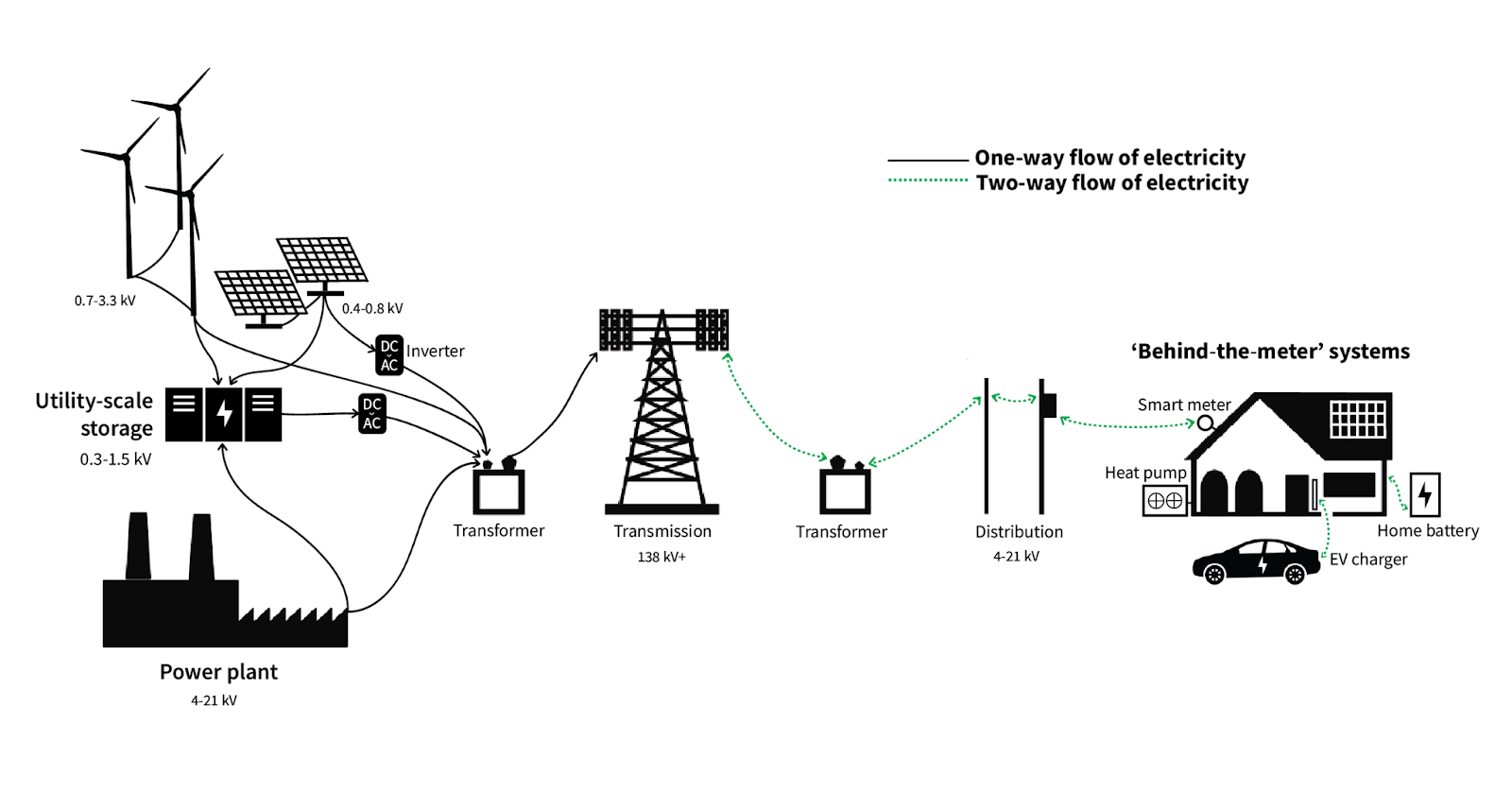
Homes and businesses can also produce electricity (e.g., rooftop solar) and use it, sell it to the grid, or store it in batteries or electric vehicles. Rooftop solar panels and residential battery systems are located ‘behind-the-meter’ - in other words, they operate on the consumer’s side of the utility meter.
Renewables Integration in Electricity Generation
Countries With the Highest Integration of Non-Hydro Renewables
Denmark 89% 🇩🇰
Lithuania 79% 🇱🇹
Kenya 69% 🇰🇪
of electricity generation comes from non-hydro renewable sources
U.S. States With the Highest Integration of Non-Hydro Renewables
Iowa 60%
South Dakota 54%
of electricity generation comes from non-hydro renewable sources
In the U.S., 17% of electricity generation comes from non-hydro renewable sources
Drivers
- Commitments to reduce GHG emissions and related policy
- Increase in electrification to replace fossil fuels
- Technological advances in renewable generation and energy storage
- Increasing cost competitiveness of renewable generation
- Distributed generation (e.g. residential rooftop solar panels) can give users more help managing growing demand and increase low-carbon generation
Barriers
- Variability of renewable energy sources, demand must match supply in real time
- Need to invest in modernization of old, outdated grid infrastructure to accommodate renewables and growing demand
- Need to update utility business models to account for distributed energy resources
- Land use impacts of additional renewable facilities, especially if overbuilding
- Technical and political barriers to regional integration of the electric grid
Our 10-Minute Take On
A Decarbonized Electric Power Sector
If you're short on time, start by watching this video of key highlights from our lecture on A Decarbonized Electric Power Sector.

Presented by: Diana Gragg, PhD; Core Lecturer, Civil and Environmental Engineering, Stanford University; Explore Energy Managing Director, Precourt Institute for Energy
Recorded: May 16, 2025
Duration: 13 minutes
If you liked this video, watch the other 10-Minute Takes here!
Before You Watch Our Lecture on
A Decarbonized Electric Power Sector
We assign videos and readings to our Stanford students as pre-work for each lecture to help contextualize the lecture content. We strongly encourage you to review the Essential videos and readings below before watching our lecture on A Decarbonized Electric Power Sector. Include selections from the Optional and Useful list based on your interests and available time.
Essential
- Can Green Energy Make the Grid Safer?. PBS Terra. March 28, 2023. (13 min)
Experts weigh in on whether we can achieve the clean energy transition in time and if our power grid will be able to handle it given how extreme our weather is getting due to climate change. - How Do Electric Utilities Make Money?. Advanced Energy Perspectives. April 23, 2015. (2 pages)
A good overview of how electric utilities currently make money.
Optional and Useful
- Big but Affordable Effort Needed for America to Reach Net-Zero Emissions by 2050, Princeton Study Shows. Seltzer, Molly. Andlinger Center for Energy and the Environment. Princeton University. December 15, 2020. (5 pages)
An overview of a Princeton study showing the U.S. could reach net-zero GHG emissions by 2050 using existing technology and at costs aligned with historical spending on energy. - How the U.S. Can Build a 100% Clean Grid. CNBC. January 27 2021. (19 min)
Describes how the current U.S. electrical grid needs to change as well as challenges and market drivers to getting there. - Understand Electrification. Stanford Understand Energy. June 22, 2026. (32 min)
What electrification is, how it works, why it's important, and the benefits and challenges of electrifying end-use services in sectors like buildings and transportation.
Our Lecture on
A Decarbonized Electric Power Sector
This is our Stanford University Understand Energy course lecture on decarbonizing the electric power sector. We strongly encourage you to watch the full lecture to understand the importance of grid decarbonization and how it can be accomplished. For a complete learning experience, we also encourage you to watch / read the Essential videos and readings we assign to our students before watching the lecture.

Presented by: Zach Ming, Adjunct Lecturer, Atmosphere and Energy, Stanford University; Director, Energy & Environmental Economics
Recorded on: April 28, 2025 Duration: 72 minutes
Table of Contents
(Clicking on a link will take you to YouTube.)
00:00 Introduction
02:54 The Changing Electricity Industry
05:07 Pillars of Decarbonization
15:28 Decarbonizing the Electricity Sector with Renewable Integration
52:37 Electrification
56:03 Retail Rate Design
1:01:54 Distributed Energy Resources & Utility Business Model

Additional Resources About
A Decarbonized Electric Power Sector
Government and International Organizations
- The International Renewable Energy Agency (IRENA) Renewable Energy Integration in Power Grids
- World Resources Institute (WRI) The State of 24/7 Carbon-free Energy: Recent Progress and What to Watch
- National Renewable Energy Laboratory (NREL) Renewable Energy-to-Grid Integration
- National Renewable Energy Laboratory (NREL) Examining Supply-Side Options to Achieve 100% Clean Electricity by 2035
- National Renewable Energy Laboratory (NREL) LA100: The Los Angeles 100% Renewable Energy Study
- Lawrence Berkeley National Laboratory (LBNL) Electricity Markets & Policy (EMP)
- US Department of Energy (DOE) On The Path to 100% Clean Electricity
- US Department of Energy (DOE) Office of Energy Efficiency & Renewable Energy Renewable Systems Integration
- US Energy Information Administration (EIA). Today in Energy Electricity Generating Fuel Mix
- US Energy Information Administration (EIA) Hourly Electric Grid Monitor
- US Office of the Federal Chief Sustainability Officer 100% Carbon Pollution-Free Electricity on a Net Annual Basis by 2030, Including 50% on a 24/7 Basis
- Pacific Northwest National Laboratory Grid Integration of Renewable Energy
- California Energy Almanac California Electricity Data
Fast Facts Sources
- Share of GHG Emissions from Electricity Generation (World 2022): Climate Watch. Historical GHG Emissions, Emissions by Sector. 2024.
- Electricity GHG Emissions Intensity (World 2017-2022): International Energy Agency (IEA). Power Sector CO2 Emissions in the Net Zero Scenario, 2000-2030. 2022; International Energy Agency (IEA). Global CO₂ Emissions by Sector, 2019-2022. 2023; U.S. Energy Information Administration (EIA). International Electricity Generation. 2024.
- Electricity GHG Emissions Intensity (U.S. 2017-2022): U.S. Environmental Protection Agency (EPA). Greenhouse Gas Inventory Data Explorer. 2024; U.S. Energy Information Administration (EIA). Electric Power Monthly. 2024.
- Electricity Generation by Major Energy Source (World 1990-2022): International Energy Agency (IEA). Energy Statistics Data Browser. 2024.
- Electricity Generation by Major Energy Source (U.S. 1990-2024): U.S. Energy Information Administration (EIA). Monthly Energy Review. 2025.
- Highest Integration of Renewables (World 2023): U.S. Energy Information Administration (EIA). International Energy Statistics. 2025.
- Highest Integration of Renewables (U.S. 2023): U.S. Energy Information Administration (EIA). Net Generation by State by Type of Producer by Energy Source, EIA-923 Report. 2024.
More details available on request.
Back to Fast Facts