
Fusion
Exploring Our Content
Check out our Energy Spotlight on Fusion!
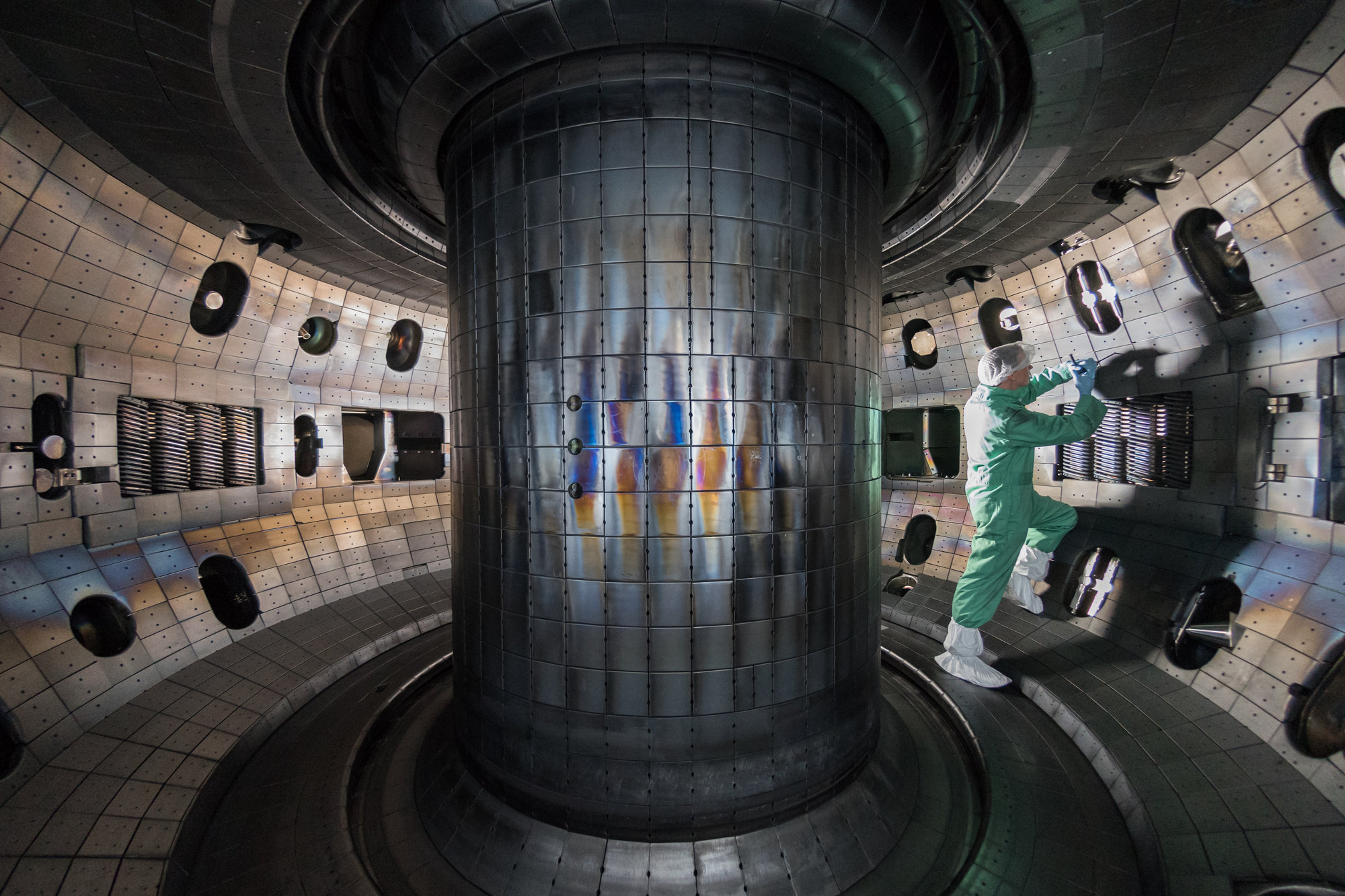
Fast Facts About
Fusion
Principal Energy Use: Electricity
Form of Energy: Nuclear
Fusion reactions power the Sun and the stars. Fusion occurs when nuclei from two or more atoms are forced together (overcoming the Coulomb barrier*) and fuse to form a single larger nucleus. The mass of the larger nucleus is slightly less than the combined mass of the original nuclei. The lost mass is converted to energy following Einstein’s equation E = mc2, yielding A LOT of energy.
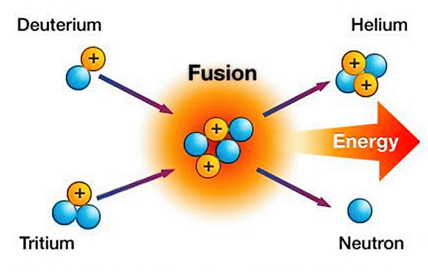
Fusion offers the possibility of an abundant carbon-free energy resource with no long-lived radioactive waste. However, fusion energy is still in the research phase because we have not yet been able to make continuous and sustainable fusion reactions happen on Earth. Making fusion happen on Earth is extremely challenging (think about putting the Sun in a box).
Three broad steps are necessary for commercially viable fusion energy:
- Make fusion happen on Earth (we’ve done this)
- Get more energy out than we put in (we’ve made significant progress)
- Achieve continuous and sustainable fusion to generate electricity in a thermal power plant (we haven’t done this)
The world spends billions of dollars every year on research to create commercially viable fusion energy, and progress is accelerating. Global investment in private fusion companies in the twelve months leading up to July 2025 was over $2.6 billion dollars, representing more than a quarter of the total private fusion investment to date, and the number of private fusion companies has more than doubled since 2021.
*The Coulomb barrier arises because the nuclei in a plasma are all positively charged and naturally repel each other. For fusion to occur, nuclei must have sufficient kinetic energy to overcome this electrostatic repulsion and get close enough to fuse.
Fusion Fuels (Hydrogen Isotopes)
Deuterium
- Abundant resource (33 mg of deuterium in every m3 of seawater, which could power over 300,000 U.S. homes for a year)
- Obtained through hydrolysis of heavy water (water with deuterium) which splits water molecules into oxygen and deuterium gas
Tritium
- Naturally occurring tritium is rare (global inventory is around 20 kg)
- Can be bred from lithium, an abundant resource (the ability to do this within the fusion reaction is important for large scale fusion power)
Fusion Fuel is Extremely Energy Dense*
14,000,000x
more energy dense than coal
6,000,000x
more energy dense than natural gas
4x
more energy dense than fission
*Energy densities measured by weight
Net Energy Production
The variable Q represents the fusion energy gain factor, which is the ratio of produced energy to injected energy.
$$Q = {produced\hspace{9px}energy \over injected\hspace{9px}energy}$$
We want Q > 1. Different levels of Q help us measure our progress toward commercial fusion. The levels are based on how we define the system.
$$Scientific\hspace{7px}Q\hspace{7px}(Q_{sci}) = {fusion\hspace{7px}energy \over energy\hspace{7px}delivered\hspace{7px}to\hspace{7px}the\hspace{5px}fusion\hspace{7px}target\hspace{7px} (e.g.,\hspace{4px}energy\hspace{7px}from\hspace{7px}lasers)}$$
$$Engineering\hspace{7px}Q\hspace{7px}(Q_{eng}) = {electricity\hspace{7px}to\hspace{7px}the\hspace{7px}grid \over electricity\hspace{7px}needed\hspace{7px}to\hspace{7px}run\hspace{7px}the\hspace{7px}entire\hspace{7px}power\hspace{7px}plant}$$
Qsci > 1 has recently been achieved
First Time
Qsci = 1.5
achieved by the National Ignition Facility (NIF) in Livermore, CA in December 2022
Highest Value
Qsci = 4.13
achieved by the NIF in April 2025
Required for commercial fusion
Qeng > 1
much more difficult to achieve than Qsci > 1
Conditions for Fusion to Occur
The Fusion Triple Product (related to the Lawson Criteria) is a convenient metric for how close a plasma* is to energy breakeven once nuclei are in the plasma state.
temperature × confinement time × plasma density > 10 21 keV s m-3
Temperature
Fusion reactions on Earth require extremely high temperatures
>100 million degrees Celsius
to put the reactants into the plasma state and overcome electrostatic forces between the nuclei to force the nuclei to fuse.
That's over 6x the temperature of the core of the sun. The sun is massive, which allows the center (where fusion occurs) to have high pressures we can't replicate on Earth. That means we must compensate by going even higher in temperature.
Confinement and Plasma Density
No solid known material on Earth is capable of physically confining plasma at >100 million degrees. That means a confinement system that doesn’t allow the plasma to touch the walls must hold the plasma in place.
*Plasma—a state of matter in which gases become ionized as atoms shed their electrons, creating an electrically charged gas with free electrons and ions
Most Common Approaches to Fusion
Gravitational confinement (like the sun uses) is not an option on Earth. The two most common approaches to fusion on Earth are magnetic and inertial confinement.
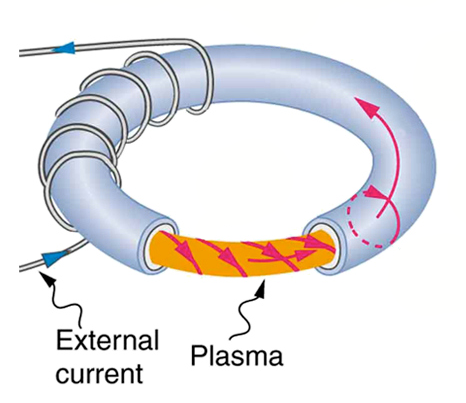
Magnetic Confinement
Uses powerful magnetic fields to confine the plasma:
- Requires relatively low plasma density and long energy confinement times (seconds)
- The tokamak is the most researched magnetic confinement design and has the most global funding of all fusion designs
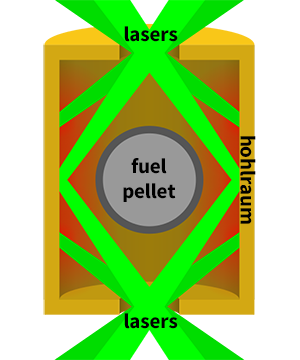
Inertial Confinement
Creates plasma and fusion with very quick bursts of energy imploding a fuel-filled target, typically using high-powered lasers:
- Requires high plasma density over a very short period (nanoseconds)
- An inertial confinement experiment holds the world record for fusion energy gain relative to energy delivered to the fusion target
There are many other fusion approaches being pursued by private companies or that have been theorized (e.g., a combination of magnets and lasers, electric currents to induce a magnetic field, electrons to induce an electric field).
Leading Fusion Endeavors
World
50+ Countries
involved in research on plasma physics and nuclear energy technology development
ITER
33 countries collaborating to build the world's largest fusion machine
50+ Private Companies
in the fusion space
>$9.7 billion
total investment to date in private fusion companies
U.S.
9 National Labs
engaged in fusion research
50+ Universities
conducting fusion research
29 Private Companies
in the fusion space
$1.4 billion
total investment in public-private partnerships, national labs, and universities from U.S. government in 2024
China was a late entrant into the nuclear fusion industry but is now investing $1.5 billion dollars per year and making rapid progress in fusion technology development.
Drivers
- The fuel is abundant (nearly inexhaustible); deuterium is common in seawater, and tritium can be bred from lithium during the fusion reaction
- No long-lived radioactive waste; the product of fusion reactions is helium
- No air emissions like GHGs, particles, etc.
- Super energy dense; net energy production is about 4 times that of fission
- Safety: unlike with nuclear fission, runaway reactions in a fusion plant are not possible. If something were to go wrong, the temperature of the plasma would decrease, the plasma would extinguish, and fusion reactions would cease
Barriers
- Technology is in the research phase
- Very energy intensive to get the fusion reaction going; reactor needs to produce more energy than what is put into it
- Fusion reactions are not yet self-sustaining
- Containment: no solid known material on Earth capable of physically confining plasma at >100 million degrees
- Regulatory approval
- Cost: fusion research is very expensive
Climate Impact: Low

- Zero operating emissions
Environmental Impact: Low
- No air pollution
- No high-level radioactive waste
- Some low-level radioactive waste that must be safely stored
Our 10-Minute Take On
Fusion
If you're short on time, start by watching this video of key highlights from our lecture on Nuclear Fusion.

Presented by: Diana Gragg, PhD; Core Lecturer, Civil and Environmental Engineering, Stanford University; Explore Energy Managing Director, Precourt Institute for Energy
Recorded: June 6, 2025
Duration: 8 minutes
If you liked this video, watch the other 10-Minute Takes here!
Before You Watch Our Lecture on
Fusion
We assign videos and readings to our Stanford students as pre-work for each lecture to help contextualize the lecture content. We strongly encourage you to review the Essential videos and readings before watching our lecture on Fusion Energy. Include selections from the Optional and Useful list based on your interests and available time.
Essential
- Fusion Energy Explained. PHD Comics. Jun 9, 2014. (8 min)
Introduces fusion energy generation concepts and ways scientists are attempting to achieve fusion energy. - Will Fusion Energy Help Decarbonize the Power System?. McKinsey. October 12, 2022. (8 pages)
A current overview of the state of fusion energy research, the investment landscape, and the near-term R&D benchmarks necessary to ascertain the viability of using fusion energy to decarbonize power systems. - The Fusion Breakthrough, Explained in 60 Seconds. Vox. December 22, 2022. (1 min)
A concise explanation of the December 2022 advancement in inertial confinement fusion energy generation. - Nuclear Fusion: Inside the Breakthrough That Could Change Our World. 60 Minutes. January 15, 2023. (13 min)
A classic framing of fusion energy and the December 2022 "breakthrough”. - Can the Dream of Fusion Power Be Realized?. Canary Media. January 15, 2024. (8 pages)
A well done overview of fusion. - Building Trust in Fusion Energy. Commonwealth Fusion Systems. June 24, 2024. (3 pages)
Outlines steps for building trust in fusion energy through transparency, evidence, and clear milestones. - Fusion News. Fusion Industry Association. November 12, 2025. (6 min)
Summary of recent fusion news.
Optional and Useful
- The U.S. Led on Nuclear Fusion for Decades. Now China Is in Position to Win the Race. CNN. September 19, 2024. (3 pages)
Examines China’s rapid advancements in nuclear fusion which are outpacing U.S. efforts. - Fusion Power: How Close Are We?. Financial Times. January 15, 2023. (28 min)
Scientists and investors in the UK discuss how close we really are to commercial fusion power. - Why Private Billions Are Flowing Into Fusion. Bloomberg Originals. July 14, 2022. (22 min)
A great explanation of fusion power and its challenges, and why private investors are investing billions. - Introduction to Fusion. MIT Plasma Science and Fusion Center. May 13, 2022. (15 min)
An overview of magnetic confinement fusion, explaining the essential features of tokamaks and stellarators reactors. - The Value of Fusion Energy to a Decarbonized United States Electric Grid. ScienceDirect. April 19, 2023. (2 pages)
A look at the value fusion plants would provide to a future decarbonized electricity system. - The U.S. Fusion Ignition Breakthrough Explained. Dr. Ben Miles. December 21, 2022. (14 min)
An explanation of the first successful fusion ignition experiment in history that was achieved through inertial confinement fusion at the Lawrence Livermore National Ignition Facility (NIF) in December 2022. - Fusion Power Explained – Future or Failure. Kurzgesagt – In a Nutshell. November 10, 2016. (6 min)
An easy-to-understand introduction to the thermonuclear process and approaches involved in building a fusion reactor.
Our Lectures on
Fusion
These are our Stanford University Understand Energy course lectures on fusion. We strongly encourage you to watch the full lecture to understand the potential role of fusion in our energy system and to be able to put this complex topic into context. For a complete learning experience, we also encourage you to watch / read the Essential videos and readings we assign to our students before watching the lecture.
Lecture 1: An Overview of Fusion Energy: Igniting a New Energy Era with Commercial Fusion Power

Presented by: Clea Kolster, PhD; Partner and the Head of Science, Lowercarbon Capital
Recorded on: May 28, 2025 Duration: 39 minutes
Lecture 2: Harnessing Star-Power — The Frontier of Matter at Extreme Conditions

Presented by: Arianna Gleason, Senior Scientist, SLAC National Accelerator Laboratory
Recorded on: September 9, 2025 Duration: 28 minutes


Additional Resources About
Fusion
Stanford University
- SLAC National Accelerator Laboratory
- Sigfried Glenzer - Nuclear physics
- Thomas Devereaux - Physics and energy science
- Stanford Plasma Physics Lab
Industry Organizations
- World Nuclear Association Nuclear Fusion Power
- Fusion Industry Association
Fast Facts Sources
- Overview: International Atomic Energy Agency (IAEA). What is Nuclear Fusion?. 2022; World Nuclear Association (WNA). Nuclear Fusion Power. 2022.
- Investment: Fusion Industry Association. The Global Fusion Industry in 2025. July 22, 2025.
- Fusion Fuels: ITER. Fueling the Fusion Reaction; ITER. Deuterium: A Precious Gift From the Big Bang. 2011.
- Fuel Density: Energy Education. Energy Density. 2024; International Atomic Energy Agency (IAEA). What is Nuclear Fusion?. August 23, 2023.
- Net Energy Production: Lawrence Livermore National Laboratory, National Ignition Facility (NIF). Achieving Fusion Ignition; Progress Toward Fusion Energy Breakeven and Gain as Measured Against the Lawson Criteria. Samuel E. Wurzel and Scott C. Hsu. Papers from the 63rd Annual Meeting of the APS Division of Plasma Physics. June 8, 2022.
- The Fusion Triple Product, Temperature: U.S. Fusion Energy. The Science of Fusion: Where the Triple Product Reigns Supreme.
- The Fusion Triple Product, Confinement: The French Alternative Energies and Atomic Energy Commission (CEA). Nuclear fusion: WEST beats the world record for plasma duration! February 18, 2025; EPJ Web of Conferences. Inertial Confinement Fusion: Recent Results and Perspectives. November 6, 2024.
- The Fusion Triple Product, Plasma Density: U.S. Fusion Energy. The Science of Fusion: Where the Triple Product Reigns Supreme; EPJ Web of Conferences. Inertial Confinement Fusion: Recent Results and Perspectives. November 6, 2024; ITER Joint Work Site. ITER and the International Scientific Collaboration.
- Fusion Energy Confinement: Institute of Electrical and Electronics Engineers (IEEE). Five Big Ideas for Making Fusion Power a Reality. 2020; World Nuclear Association (WNA). Nuclear Fusion Power. 2022.
- Leading Fusion Endeavors: ITER. What is ITER?. 2025; UK Atomic Energy Authority, Culham Center for Fusion Energy. Fusion in Brief; Fusion Industry Association (FIA). The Global Fusion Industry. July 22, 2025; Fusion Industry Association (FIA). Congress Provides Record Funding for Fusion Energy; World Economic Forum. Nuclear Fusion News: The Science Behind the Energy Technology, Explained. February 22, 2024.
- Drivers and Barriers: UK Atomic Energy Authority, Culham Center for Fusion Energy. Fusion in Brief; Fusion Industry Association. The Global Fusion Industry. 2024; US Department of Energy (DOE). Deuterium-Tritium Fusion Fuel; Goldston, R. & Glaser, A. Safeguards for Fusion Energy Systems. 2022; International Atomic Energy Agency (IAEA). What is Nuclear Fusion?. 2022; ITER. Advantages of Fusion.
More details available on request.
Back to Fast Facts