
Hydropower
Exploring Our Content
Check out our Energy Spotlight on hydropower!
Fast Facts About
Hydropower
Principal Energy Use: Electricity
Forms of Energy: Gravitational/Motion
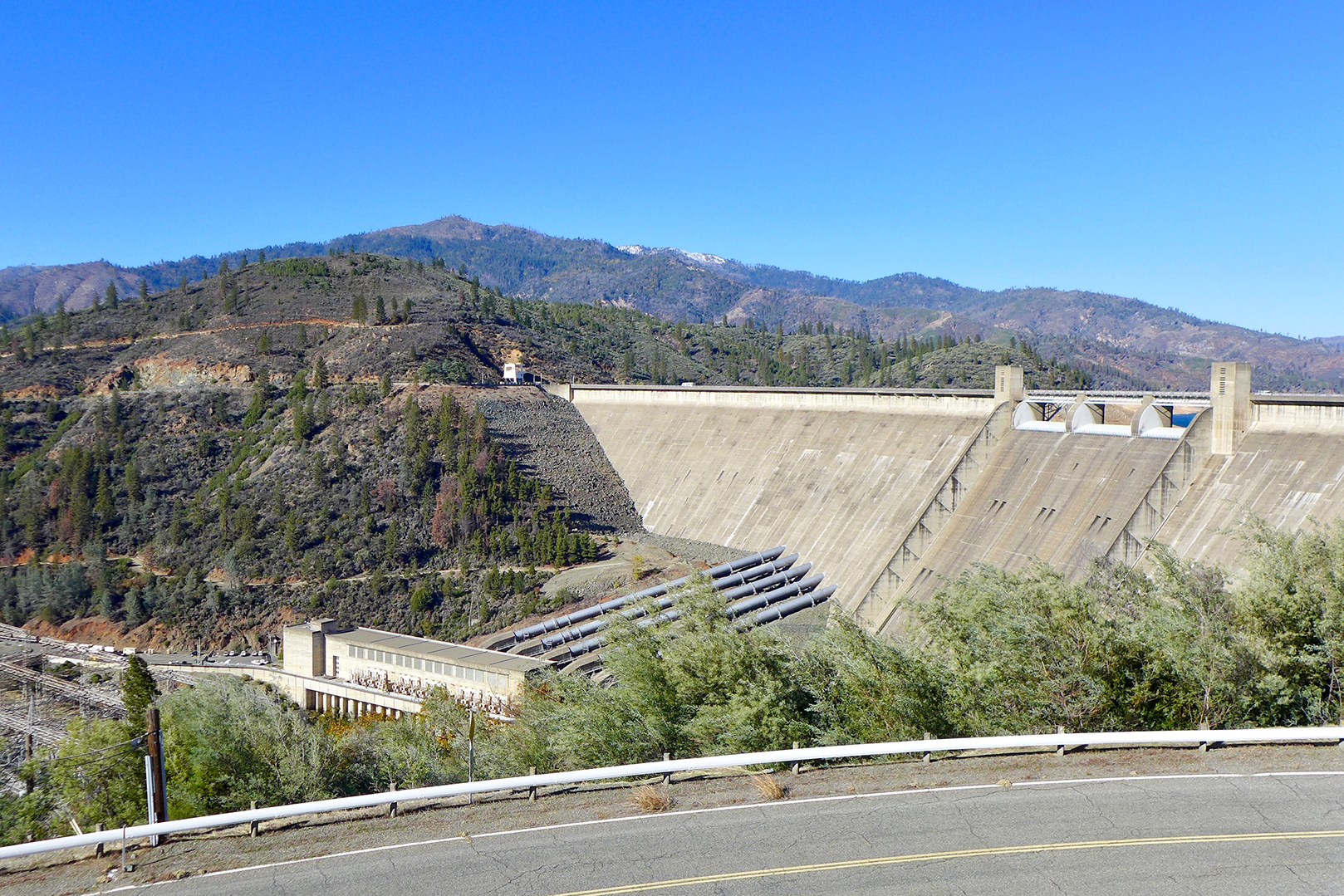
Hydropower, also known as hydroelectricity, is a semi-renewable resource that uses the power of flowing water to generate electricity. We categorize this resource as semi-renewable, because it must be carefully managed to ensure we are not using the water faster than nature can replenish it. The two major configurations for generating electricity from hydropower are storage hydroelectric systems and run-of-river systems.
- Storage hydroelectric systems (dams) store water and energy in reservoirs (artificial lakes). Storage provides flexibility for when electricity generation occurs, but can be disruptive to the local environment. For example, the creation of a reservoir changes the river’s natural flow and results in the flooding of large areas of land, impacting ecosystems and communities.
- Run-of-river systems primarily use the river’s natural flow to generate electricity. Some store small amounts of water (pondage) and some don’t store water at all, generally resulting in less disruption to the natural river system. However, they can still block fish passage, alter water temperature, and flood vegetation. Run-of-river systems are less flexible than storage systems because their electricity output is more tied to the rises and falls in the natural river flow.
Pumped storage hydropower (pumped hydro) facilities are designed to store energy, not generate electricity. Operators use electricity to pump water up to a higher elevation reservoir to store potential energy for use at a later time, and then release the water to generate electricity when needed. Closed loop pumped hydro systems have two stand-alone reservoirs—an upper reservoir and a lower reservoir. In an open loop pumped hydro system, the upper or lower reservoir is continuously connected to a naturally flowing water source (e.g., river or lake).
Note: The small amount of marine/ocean-based hydropower is not included in this data and is covered on our Ocean Energy page.
Significance
Energy Mix
3% of world 🌎
1% of U.S. 🇺🇸
Electricity Generation
14% of world 🌎
6% of U.S. 🇺🇸
Hydroelectric Capacity by Type
Storage (Dams) and Run-of-River Systems
(Electricity Generation)
86%
Pumped Hydro Systems
(Energy Storage)
14%
Global Electricity Generation from Hydropower
Increase:
⬆3%
(2020-2025)
World
Most Installed Capacity
China 30% 🇨🇳
of global hydroelectric generation installed capacity (excluding pumped hydro)
Most Generation
China 31% 🇨🇳
of global hydroelectricity generation
Highest Penetration
Bhutan, Central African Republic, Lesotho, Paraguay, Nepal, Ethiopia, Albania >95%
of country’s electricity generation comes from hydroelectricity
Seven of the Ten Largest Power Plants in the World by Capacity are Hydropower
| Rank by Capacity | Power Plant | Capacity | Type |
|---|---|---|---|
| 1 | Three Gorges Dam, China | 22,500 MW | Hydropower |
| 2 | Baihetan Dam, China | 16,000 MW | Hydropower |
| 3 | Gonghe Talatan Solar Park, China | 15,600 MW | Solar |
| 4 | Itaipu Dam, Brazil-Paraguay | 14,000 MW | Hydropower |
| 5 | Xiluodu Dam, China | 13,860 MW | Hydropower |
| 6 | Belo Monte Dam, Brazil | 11,233 MW | Hydropower |
| 7 | Guri Dam, Venezuela | 10,235 MW | Hydropower |
| 8 | Wudongde Dam, China | 10,200 MW | Hydropower |
| 9 | Jebel Ali Natural Gas Power Station, UAE | 8,695 MW | Natural gas |
| 10 | Kashiwazaki-Kariwa Nuclear Power Plant, Japan | 7,965 MW | Nuclear |
U.S.
Most Installed Capacity
Washington 27%
of U.S. hydroelectric generation installed capacity
Most Generation
Washington 26%
of U.S. hydroelectricity generation
Highest Penetration
Washington 63%
of state’s electricity generation comes from hydroelectricity
Note: These figures do not account for non-utility scale or off-grid hydropower generation.
Pumped Hydro (Energy Storage)
Energy storage projects are rated on power capacity (e.g., MW) and energy capacity (e.g., MWh). The capacity data below are based on power capacity unless otherwise noted.
Most Installed Capacity
China 33% 🇨🇳
of global pumped hydro installed capacity
Share of Global Energy Storage Capacity
Pumped Hydro: 43%
Lithium-ion Batteries: 56%
Pumped Hydro “Roundtrip” Efficiency
~80%
of the energy used to pump water uphill can be converted back into electricity
This is similar to utility-scale battery storage.
Global Pumped Hydro Capacity
Increase:
⬆23%
(2020-2025)
While battery energy storage overtook pumped hydro for energy storage power capacity (GW) in 2025, pumped hydro has higher energy capacity (GWh) globally.
Drivers
- Abundant hydro resource
- Electricity generation can be a co-benefit to dams built for flood control, water storage for agricultural, residential, commercial, recreational purposes
- Energy security
- Mature, reliable technology
- Can be used to "black start" the electricity grid after major outages*
- Qualifies under some nations' renewable energy targets (although large hydro may not count in some jurisdictions due to environmental impacts)
- Financial incentives such as production tax credits (PTC) and feed-in tariffs
- Supports integration of intermittent renewables
Barriers
- Site-specific resource, only available in some geographies
- Droughts and climate change can impact water cycle, changing long-term resource availability
- Competing downstream uses for water can limit its use for electricity generation
- Downstream fish passage through or around the powerhouse can injure or kill fish
- Battery storage is gaining market share relative to pumped hydro due to falling costs and other advantages
Dams and reservoirs**
- Destruction of cultural heritage sites and human settlements, forcing mass relocation and compensation
- Flooding of terrestrial habitat, disrupting ecosystems that rely on lakes and rivers
- Impacts on aquatic species (e.g., fish mortality and barriers to migration); may also be culturally and economically important to Indigenous communities
- Disruption of ecosystems that are culturally and economically important to Indigenous and local communities
- Impacts on water quality, temperature, and nutrient flux
- Seismic impacts from large reservoirs
- Expensive initial capital costs to build dams
- Lengthy planning, permitting, and construction process
- Local opposition to dam construction (NIMBY/BANANA***)
- Inconsistent policy support
- Movement to remove dams due to environmental harms
*Black start - recovering from a blackout by individually restarting power systems and gradually reconnecting them to form an interconnected grid
**Some of these barriers are relevant to run-of-river systems as well
***NIMBY - not in my backyard; BANANA - build absolutely nothing anywhere near anything
Climate Impact: Low to Medium

- Relatively low GHG emissions on average
- Reservoirs created by dams can flood ecosystems upstream, releasing significant amounts of methane (a potent GHG) as vegetation decomposes
Environmental Impact: Low to Medium
- No air pollution
- Dams can submerge natural habitat, cultural heritage sites, and human settlements, potentially displacing tens of thousands
- Impacts to aquatic ecosystems can disrupt life cycles by blocking or injuring migratory species
- Some run-of-river systems can avoid major environmental impacts
Our 10-Minute Take On
Hydropower
If you're short on time, start by watching this video of key highlights from our lecture on Hydropower.

Presented by: Diana Gragg, PhD; Core Lecturer, Civil and Environmental Engineering, Stanford University; Explore Energy Managing Director, Precourt Institute for Energy
Recorded: July 11, 2025
Duration: 13 minutes
If you liked this video, watch the other 10-Minute Takes here!
Before You Watch Our Lecture on
Hydroelectric Power
We assign videos and readings to our Stanford students as pre-work for each lecture to help contextualize the lecture content. We strongly encourage you to review the Essential videos and readings below before watching our lecture on Hydroelectric Power. Include selections from the Optional and Useful list based on your interests and available time.
Essential
- Hydroelectric Power Plant Virtual Tour. MidAmerican Energy. October 4, 2013. (10 min)
A history of hydropower in the U.S. and an overview of how a hydroelectric power plant works. - U.S. hydropower is at a make-or-break moment. Canary Media. October 1, 2025. (5 pages)
Summarizes how costly, slow relicensing puts major U.S. hydropower capacity at risk without reforms to streamline permitting and support upgrades. - Is It a Lake, or a Battery? A New Kind of Hydropower Is Spreading Fast. The New York Times. May 2, 2023. (1 page)
A good explanation of pumped storage and how it is rapidly expanding. - What Is the Future of Hydropower?. CNBC. May 28, 2022. (16 min)
Examines the role of hydropower in the transition to a fossil fuel-free world. - Three Gorges Dam Project. Ali Kazi. November 18, 2012. (7 min)
An overview of the world's largest hydropower plant.
Optional and Useful
- Hydropower. NEED.org. 2025. (4 pages)
An excellent overview of hydropower. - Global Status Report, Renewables in Energy Supply, Hydropower. REN21. 2025. (5 pages)
Market and industry trends for hydropower. - State Water Project: An Aerial Tour 2021. California DWR. May 11, 2021. (11 min). Sacramento Bee. May 12, 2021. (11 min)
An aerial tour of the California State Water Project. - California Hydroelectric Facilities Continue to Respond to Prices Despite Drought. EIA Today in Energy. December 1, 2021. (1 page)
How California's hydropower generation responded to higher late afternoon electricity prices in 2021 during drought conditions. - Drought Effects on Hydroelectricity Generation in Western U.S. Differed by Region in 2021. EIA Today in Energy. March 30, 2022. (1 page)
Shows how hydropower generation in California and the Pacific Northwest responded differently to drought conditions in 2021. - Dam Reservoirs May Be Much Bigger Sources of Carbon Emissions Than We Thought. Popular Science. May 14, 2021. (2 pages)
Discusses new research showing that dams may release potentially huge amounts of carbon. - Rethinking Hydropower for Energy & Environmental Sustainability. CleanTechnica. April 24, 2021. (1 page)
Describes a new approach to hydropower—small, cascading installations designed to preserve river connectivity. - Brazil: Drought Hits Hydropower Plants, Bolsonaro Asks People to Cut Down on Power Consumption. WION. September 10, 2021. (1 min)
The impacts of drought on Sao Paulo, an area dependent on hydroelectric power. - Hydropower & Pump Storage | Dan Reicher | StorageX International Symposium. Stanford Energy. September 24, 2021. (90 min)
Dan Reicher of Stanford University speaks on hydropower and pump storage.
Our Lecture on
Hydroelectric Power
This is our Stanford University Understand Energy course lecture on hydropower. We strongly encourage you to watch the full lecture to understand hydroelectric power as an energy system and to be able to put this complex topic into context. For a complete learning experience, we also encourage you to watch / read the Essential videos and readings we assign to our students before watching the lecture.

Presented by: David Freyberg, PhD; Associate Professor, Civil and Environmental Engineering, Emeritus, Stanford University
Recorded on: May 21, 2025 Duration: 74 minutes

Additional Resources About
Hydropower
Stanford University
- Earth System Science Department
- Water Resources and Hydrogeology Program
- Steven Gorelick - Groundwater management, hydrology
- Stanford Woods Institute for the Environment
Industry Organizations
Fast Facts Sources
- Energy Mix (World 2025): Energy Institute. Statistical Review of World Energy. 2026.
- Energy Mix (U.S. 2025): U.S. Energy Information Administration (EIA). Total Energy: Energy Overview, Table 1.3. 2026.
- Electricity Mix (World 2025): Energy Institute. Statistical Review of World Energy. 2025.
- Electricity Mix (U.S. 2025): U.S. Energy Information Administration (EIA). Total Energy: Electricity, Table 7.2a. 2026.
- Installed Capacity (World 2025): International Hydropower Association (IHA). World Hydropower Outlook. 2026.
- Global Generation Change (World 2020-2025): Energy Institute. Statistical Review of World Energy. 2026.
- Most Installed Capacity (World 2025): International Hydropower Association (IHA). World Installed Capacity and Generation. 2026.
- Most Generation (World 2025): Energy Institute. Statistical Review of World Energy. 2026.
- Highest Penetration (World 2025): Our World in Data. Share of Electricity Production from Hydropower. 2026
- Largest Power Plants by Capacity (World 2025): Wion. Nuclear, Hydro, and Solar: 10 Largest Power Plants on Earth. November 5, 2025.
- Most Installed Capacity (U.S. 2024): U.S. Energy Information Administration (EIA). Electric Power Annual, Table 4.7.B. 2026.
- Most Generation (U.S. 2025): U.S. Energy Information Administration (EIA). Electricity Data Browser, Net Generation for All Sectors. 2026.
- Highest Penetration (U.S. 2025): U.S. Energy Information Administration (EIA). Electricity Data Browser, Net Generation for All Sectors. 2026.
- Pumped Hydro Most Installed Capacity (World 2025): International Hydropower Association (IHA). World Installed Capacity and Generation. 2026.
- Pumped Hydro Share of Global Storage Capacity (2025): China Energy Storage Alliance (CNESA). White Paper. 2026.
- Pumped Hydro Efficiency: U.S. Energy Information Administration (EIA). Today in Energy. Utility-Scale Batteries and Pumped Storage Return about 80% of the Electricity They Store. February 12, 2021.
- Change in Global Pumped Hydro Capacity (2020-2025): China Energy Storage Alliance (CNESA). White Papers. 2021, 2026.
- Cumulative Installed Capacity of Energy Storage (2018-2025): China Energy Storage Alliance (CNESA). White Papers. 2019, 2020, 2021, 2022, 2023. 2024. 2025. 2026.
More details available on request.
Back to Fast Facts