
Energy for Buildings
Exploring Our Content
Check out our Energy Spotlight on electrification!

Fast Facts About
Energy for Buildings
Buildings are responsible for approximately 40% of global CO2 emissions. Building-related emissions fall into two main categories:
- Embodied carbon: Emissions from the manufacturing of building materials (especially cement, steel, and glass) and the building’s construction
- Operational carbon: Emissions from a building’s energy consumption for services such as heating, cooling, lighting, and operating various appliances
Decarbonizing buildings is crucial in the efforts to mitigate climate change, and it can deliver many co-benefits, such as improved comfort and productivity, increased retail sales, and reduced costs.
Decarbonizing buildings requires a multi-faceted approach, including:
- Energy efficiency
- Electrification
- Increased use of renewable energy sources
- Adoption of sustainable building practices and materials
- Supportive policies and regulations
In addition to reducing emissions, decarbonizing buildings reduces energy consumption and improves health and indoor environmental quality.
Share of Emissions from Buildings
World ~40% 🌎
of global CO2 emissions
U.S. 31% 🇺🇸
of U.S. GHG emissions
Share of Final Energy Used by Buildings
World 34% 🌎
of global total final energy
U.S. 28% 🇺🇸
of U.S. total final energy
Share of Energy Final Used in Buildings From Renewable Resources
World 18% 🌎
U.S. 15% 🇺🇸
of total final energy used in buildings comes from renewable resources
U.S.
45% of energy consumed in U.S. residential buildings is electricity
60% of energy consumed in U.S. commercial buildings is electricity
Biggest Opportunities for Energy Efficiency and Decarbonization
- Efficient building envelope (e.g., high performance windows - a home’s largest source of heat loss, insulation)
- Lighting - use of natural light and LED lights
- Improved HVAC systems and ductless heat pumps
- Electrification of space heating and natural gas appliances (stoves, dryers, water heaters)
Effective Sustainable Building Design Practices
- Integrative design - optimize whole systems rather than components in isolation
- Application of energy efficiency best practices
- Maximization of natural light and ventilation
- Use of sustainably sourced natural materials
- Reduction of friction in piping systems through size and layout to ensure smooth transitions
- Optimal building orientation
Steps to Reduce Operational Carbon in a Typical Building
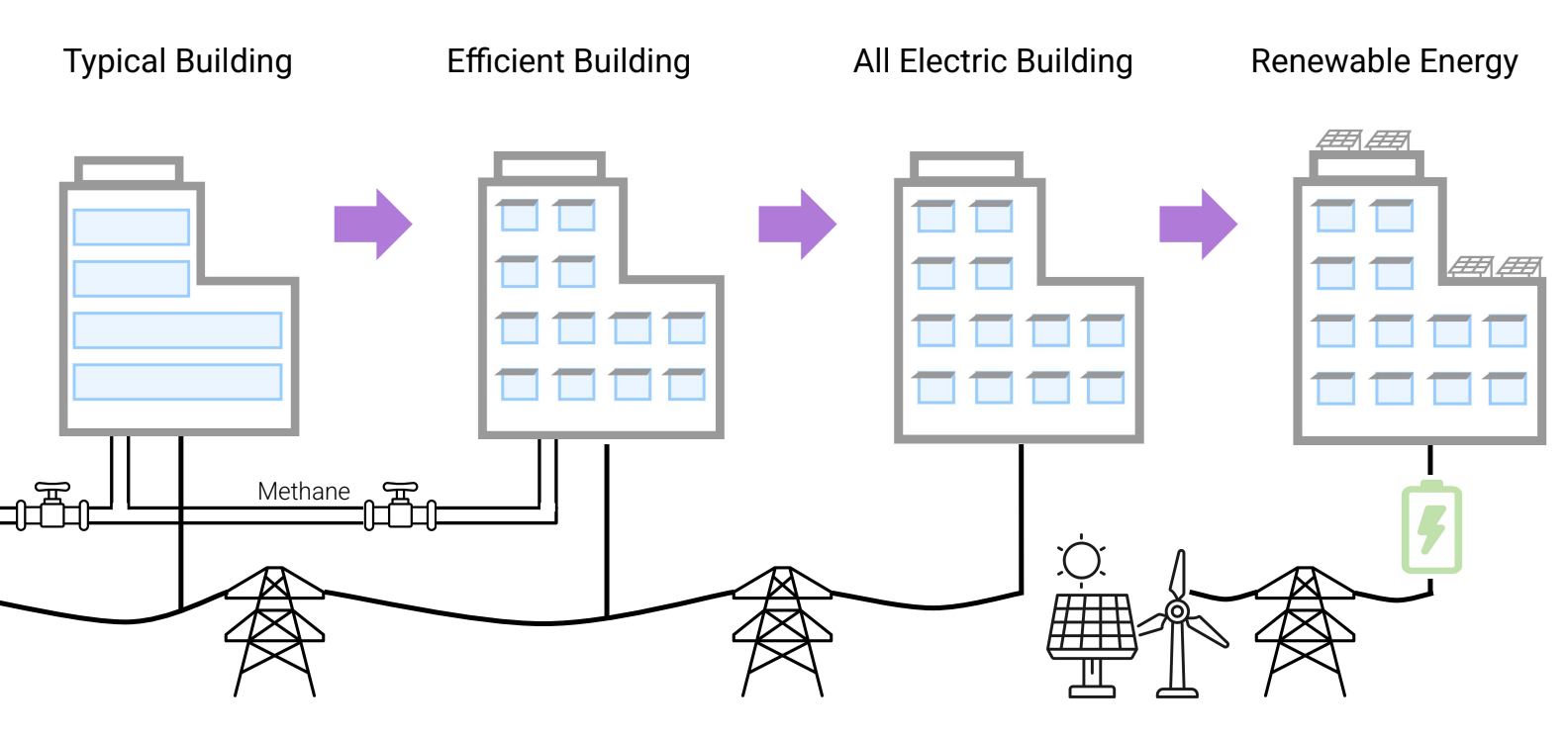
| Step | Goal | Examples |
|---|---|---|
| Make the building energy efficient | Reduce energy consumption without compromising the service |
|
| Electrify everything | Electrify everything |
|
| Connect to renewable energy | Provide low- or no-carbon power supply |
|
Drivers
- Reduced costs for building operation and maintenance
- Increased worker productivity and comfort
- Better indoor air quality with health benefits
- Higher lease rates and resale values for green buildings
- Greater resilience to energy price volatility and grid outages for green buildings
- Increased retail sales in naturally lit spaces
- Supportive policies such as mandatory energy-efficient building codes in some regions
- Available financing mechanisms that reduce upfront costs (e.g., on-bill financing)
Barriers
- Efficiency upgrades must be paid for up-front, and there may be a long cost recovery time
- Upfront costs can be prohibitive if not applied correctly (i.e., optimizing in isolation as opposed to applying principles of integrative design)
- Emphasis on short-term returns can lead to missed opportunities, as many significant energy savings or decarbonization projects require longer periods to break even (payback trap)
- “Split incentives” between those paying the costs of efficiency measures and those enjoying the savings (e.g., owner vs tenant)
- Lack of access to financing for lower-income populations
- Price distortions caused by fossil fuel subsidies
- Lack of mandatory energy-efficient building standards or codes in some regions
- Risk aversion among managers regarding adopting new, untested technologies, even if they have the potential to improve energy efficiency (manager barrier)
- Long building lifespans mean slow turnover – buildings can operate for 50-100+ years, delaying opportunities for upgrades
- Low consumer awareness of efficiency and decarbonization options
- Lack of skilled workforce in renewable heat and energy efficiency installation
Climate Impact: High

- Leading source of GHG emissions
Environmental Impact: High
Construction:
- Land use
- Mining for building materials
- Noise pollution
- Unsustainable wood harvesting
- Potentially hazardous building materials
- Construction debris
Operational:
- Air pollution
- Waste
- Water use
Our 10-Minute Take On
Energy for Buildings
If you're short on time, start by watching this video of key highlights from our lecture on Buildings, Energy, and Decarbonization.

Presented by: Diana Gragg, PhD; Core Lecturer, Civil and Environmental Engineering, Stanford University; Explore Energy Managing Director, Precourt Institute for Energy
Recorded: August 22, 2025
Duration: 11 minutes
If you liked this video, watch the other 10-Minute Takes here!
Before You Watch Our Lecture on
Energy for Buildings
We assign videos and readings to our Stanford students as pre-work for each lecture to help contextualize the lecture content. We strongly encourage you to review the Essential readings below before watching our lecture on Buildings, Energy, and Decarbonization. Include selections from the Optional and Useful list based on your interests and available time.
Essential
- How Building Decarbonization Can Transform HVAC. ASHRAE Journal Vol. 63, no. 9. September 1, 2021. (12 pages)
Explores heat pump systems as one way building decarbonization can transform HVAC. - A Roadmap to Decarbonize California’s Buildings. Building Decarbonization Coalition. February 12, 2019. (16 pages)
A roadmap for overcoming barriers that are preventing California from reaching its potential for decarbonizing buildings. - Report: Utilities Can Lessen Winter Power Outage Risk by Investing in Home Efficiency. ACEEE. April 15, 2021. (1 page)
Shows how utilities' investments to improve home energy efficiency can help tackle cold-weather electricity challenges. - We Already Have the Low-Cost Tools We Need to Cut the Carbon Hidden in Buildings. Canary Media. August 24, 2021. (4 pages)
Shows how materials and technologies available today can slash "embodied carbon" nearly in half.
Optional and Useful
- Global Status Report, Renewables in Energy Demand, Renewable Energy in Buildings. REN21. 2025. (6 pages)
An overview of global energy use in buildings and the share provided by renewables. - US Home Heating is Fractured in Surprising Ways: Look Up Your Neighborhood The Washington Post. March 6, 2023. (3 pages)
Map showing the four main ways Americans heat their homes by region. - New York Passes First Statewide Ban On Gas In New Buildings. Canary Media. May 3, 2023. (2 pages)
A look at New York's first-in-the-nation statewide ban on gas in new buildings. - Texas Failed Because It Did Not Plan. The Atlantic. February 21, 2021. (4 pages)
Offers three explanations for why Texas' power grid failed. - 30-Story Building Built in 15 Days (Time Lapse). Broad Group. January 8, 2012. (2 min)
Time lapse video of a 30-story hotel being built in China in 360 hours. - Understand Electrification. Stanford Understand Energy. June 22, 2026. (32 min)
What electrification is, how it works, why it's important, and the benefits and challenges of electrifying end-use services in sectors like buildings and transportation.
Our Lecture on
Energy for Buildings
This is our Stanford University Understand Energy course lecture on energy for buildings. We strongly encourage you to watch the full lecture to understand the importance of decarbonizing buildings and to be able to put this complex topic into context. For a complete learning experience, we also encourage you to review the Essential readings we assign to our students before watching the lecture.

Presented by: Peter Rumsey, PE, FASHRAE; Adjunct Lecturer, Civil and Environmental Engineering, Stanford University; President and Founder, Decarbonization Strategies, Inc.
Recorded on: June 2, 2025 Duration: 64 minutes
Additional Resources About
Energy for Buildings
Stanford University
- The Stanford Building Decarbonization Learning Accelerator
- Stanford Engineering Center for Integrated Facility Engineering (CIFE)
- Sustainable Stanford Green Buildings
- Civil and Environmental Engineering Department
- Sustainable Design & Construction (SDC)
- Sarah Billington - Sustainable, durable construction materials; use of renewable materials to make structural insulated panels, which improve heating and cooling efficiency in buildings
- Amory Lovins - Superefficient buildings, integrative design
- Kyle Douglas - Energy efficient buildings, sustainable concrete
- Martin Fischer - Design and construction of sustainable buildings
- Lynn Hildemann - Effects of energy-efficient building design strategies on indoor pollutant levels
- Martin Lepech - Integration of energy and environmental performance indicators, value and payback time in design of energy-efficient buildings
- Raymond Levitt - Ways for the construction industry to overcome barriers to adopting energy-efficient innovations
- Chemical Engineering Department
- Curtis Frank - Green construction materials
- Mechanical Engineering Department
- Kenneth Goodson - Novel materials for thermoelectric waste-heat recovery in buildings
- Gianluca Iaccarino - Modeling natural ventilation in energy efficient buildings using high-fidelity simulations
- Electrical Engineering Department
- Leonid Kazonsky - Green networks for office and residential buildings
- Graduate School of Business
- Erica Plambeck - The construction industry’s barriers to adopting energy-efficiency innovations
- Physics Department
- Steven Chu - The effect of energy efficiency standards in appliances and buildings
Industry Organizations
Fast Facts Sources
- Emissions Attributed to Buildings (World): United Nations Environment Programme (UNEP). Global Status Report for Buildings and Construction. 2026; Architecture30. Why the Built Environment?
- Emissions Attributed to Buildings (U.S. 2022): U.S. Environmental Protection Agency (EPA). Commercial and Residential Sector Emissions. 2025.
- Final Energy Used by Buildings (World 2023): United Nations Environment Programme (UNEP). Global Status Report for Buildings and Construction. 2025.
- Final Energy Used by Buildings (U.S. 2023): U.S. Energy Information Administration (EIA). How much energy is consumed in U.S. buildings? 2024.
- Renewable Energy Used by Buildings (World 2022): REN21. Renewable Energy in Buildings. 2025.
- Renewable Energy Used by Buildings (U.S. 2022): REN21. Renewable Energy in Buildings. 2025.
- Residential Building Energy and Electricity Consumption by End Use (U.S. 2020): U.S. Energy Information Administration (EIA). Residential Energy Consumption Survey. Detailed End Use Consumption Estimates. 2023.
- Commercial Building Energy and Electricity Consumption by End Use (U.S. 2018): U.S. Energy Information Administration (EIA). Commercial Buildings Energy Consumption Survey (CBECS). 2020.
More details available on request.
Back to Fast Facts