
Understand Geothermal Energy

Happy spring! April is Earth Month, a time to celebrate the Earth’s natural resources and think about how our actions impact our planet. With that in mind, this edition of Stanford University’s Understand Energy Learning Hub newsletter features Geothermal Energy—using heat from the Earth’s core for heating and electricity. If you like what you see, please share with your friends and family and encourage them to subscribe.
What you need to know
Significance: Geothermal is experiencing an amazing renaissance in investment and project development thanks to enhanced geothermal technologies. Although it is just a tiny portion (much less than 1%) of the world’s energy mix, it is often an important resource in locations where it’s available. For example, geothermal meets 90% of 🇮🇸 Iceland’s heating demand and 30% of their electricity demand. It also supplies almost half of 🇰🇪 Kenya’s electricity. Geothermal energy can be a carbon-free resource for providing 24/7 electricity to the grid.
What is geothermal energy? Geothermal energy uses the abundant natural heat deep below the Earth’s surface to provide direct heat and generate electricity. Geothermal resources are most accessible where the Earth’s crust is thin or faulted or near volcanic activity, which often occurs near tectonic plate boundaries.
A conventional geothermal reservoir
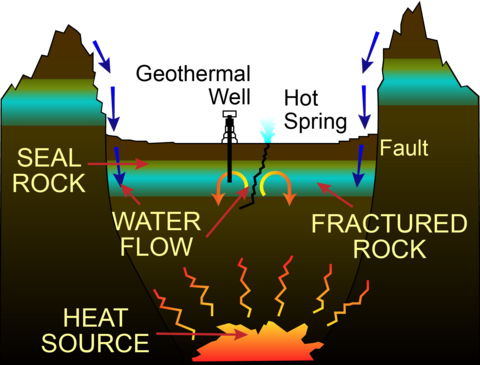
Three things are needed in a conventional geothermal resource–heat, permeability, and water.
- A heat source: Heat from the Earth flows upward either by conduction or in the form of magma (molten rock).
- Permeable rock: A fractured rock reservoir to store heated water (or rarely steam) and permit flow.
- Water: To carry heat to the surface for direct use or electricity generation.
We categorize geothermal as a semi-renewable resource because managing the water and the pressure in a geothermal reservoir is critical to the sustainable functioning of the resource.
The Geysers: A case study in geothermal resource management
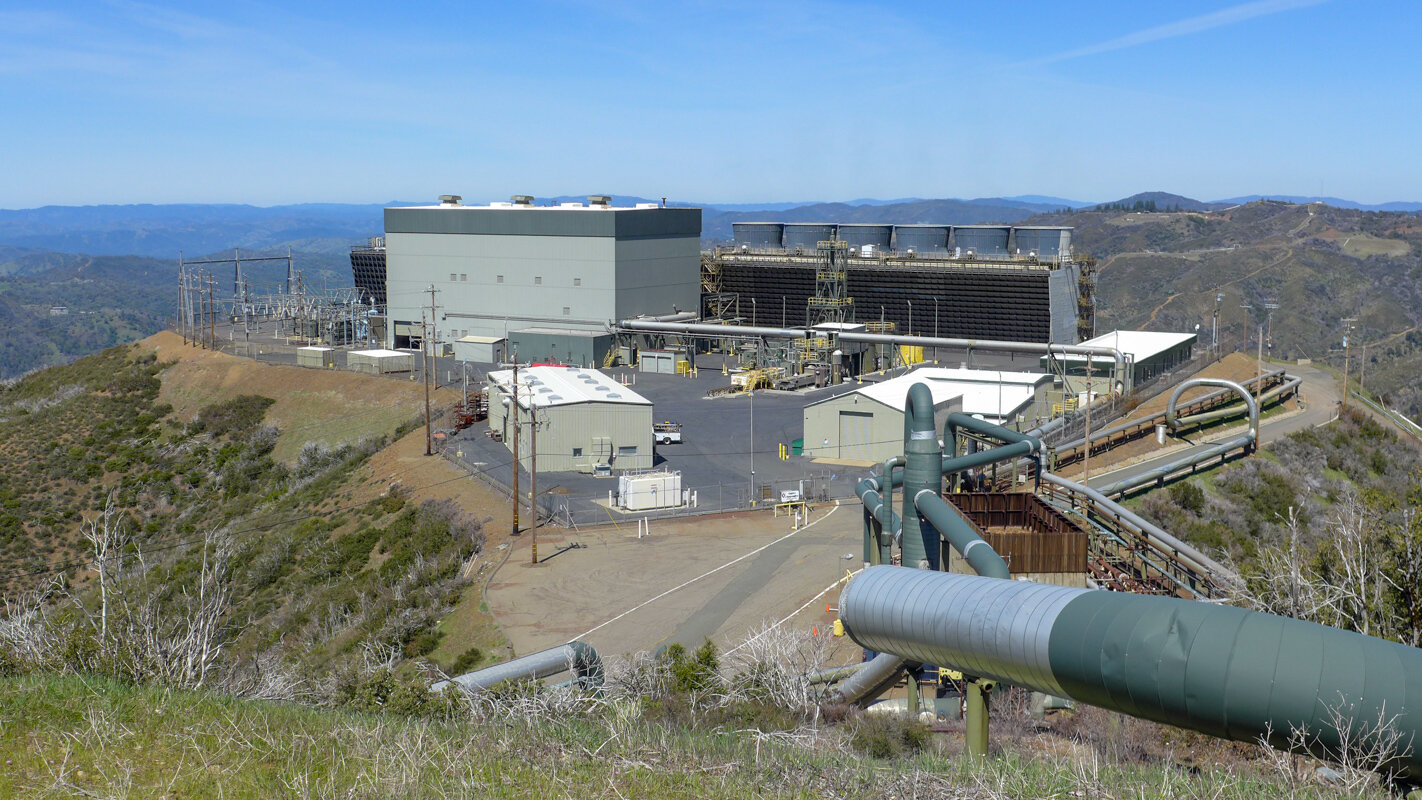
The Geysers, located in Northern California, is the world’s largest geothermal power plant complex and a rare dry steam resource, where very high temperatures in the ground directly create steam. Originally established in 1960 with an 11 MW plant, The Geysers reached an installed capacity of 1,875 MW in 1990. Unfortunately, during the 1970s and 1980s, far more steam was produced from the reservoir than was replaced due to multiple operators competing for the same resource, a “tragedy of the commons." By 1989, that overdevelopment had significantly reduced pressure in the reservoir, decreasing the rate of steam production and threatening the reservoir’s viability for sustainable power generation. In 1997, a project between The Geysers and local and federal government agencies began delivering treated wastewater for injection into the reservoir to maintain pressure and stabilize the resource. In 2000, Calpine acquired 19 geothermal power plants in The Geysers, which consolidated ownership and allowed for a field-wide approach to sustainably managing the resource. Today, the net generating capacity is 900 MW due to resource depletion and the retirement of some power plants. Learn more about The Geysers.
How do we find and develop geothermal reservoirs? Finding geothermal reservoirs is often difficult and expensive. Geologists and geophysicists are able to identify likely locations, but drilling is required to confirm that reservoir conditions exist. Drilling a well can cost millions of dollars and doesn’t always yield results, which can make geothermal exploration financially challenging. Geothermal drilling is a lot like oil and gas drilling but it can take longer and result in more wear and tear on the equipment because the rock is often harder (igneous vs. sedimentary) and the ground is much hotter—which is what we want!
How hot is hot? When using geothermal energy to generate electricity, the three main types of power plants are dry steam, flash steam, and binary. Each requires a different reservoir temperature.

- Dry steam plants use the hottest and rarest reservoirs, requiring temperatures >455°F or >235°C. Only two dry steam locations are currently used in the world: The Geysers (mentioned earlier) and Larderello, which is in Tuscany, Italy.
- Flash steam plants require mid-range reservoir temperatures >360°F or >182°C and are the most common type of geothermal power plant.
- Binary plants can operate in lower temperature reservoirs, requiring temperatures >212°F or >100°C. They are the fastest growing type of geothermal power plant.
Direct heating is typically a lower temperature service, so it can make use of a wide range of geothermal reservoir temperatures. Some of the main geothermal direct heat uses are bathing and swimming (hot springs!), space heating, and greenhouse heating.
Geothermal heat pumps do not use geothermal energy
Heat pumps transfer heat from a cold space to a warm space (e.g., your refrigerator moves heat from inside your refrigerator into your kitchen and your air conditioner moves heat from your house to the hot outdoors). Geothermal heat pumps (also called ground source heat pumps) transfer heat to and from the ground instead of to and from the air, which is much more energy efficient. Even though they are called geothermal heat pumps, they do not use heat from the Earth’s core. Learn more about how geothermal heat pumps work.
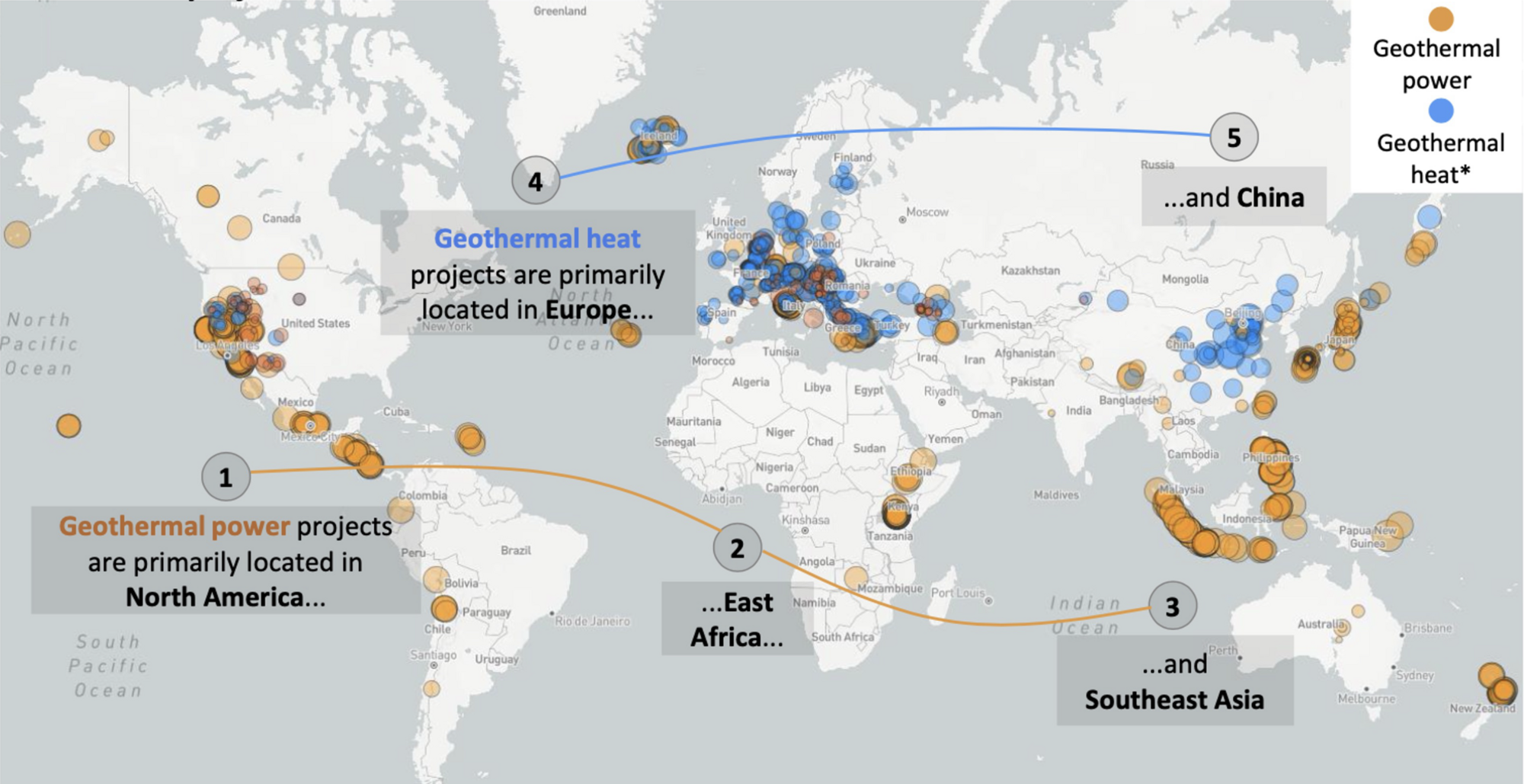
Where is geothermal used? The U.S. is the leader in installed geothermal electricity with 18% of the world's capacity. Indonesia is a close second with 16%. Kenya relies on geothermal energy for electricity more than any other country. Forty-four percent of their electricity is produced from geothermal.China is by far the biggest user of geothermal for direct heat, representing almost 60% of the global geothermal heat market. China, Turkey, Iceland, and Japan combined account for over 90% of geothermal direct use heat. Iceland has the highest penetration, with 90% of their heating provided by geothermal.
Geothermal project locations
Kenya’s federal policies derisk geothermal exploration
Kenya’s location offers abundant geothermal resources. To take advantage of those resources, Kenya's government has invested in geothermal research and development. They use public dollars to help derisk geothermal exploration and then let private companies develop the resources.
Environmental impacts
Direct heat, dry steam, and flash steam geothermal can all emit air pollutants such as hydrogen sulfide (H2S) and carbon dioxide (CO2), but the emissions are much lower than the emissions from fossil fuels.
Binary geothermal power plants are carbon free and emit no air pollution. They operate in a self-contained system, so geothermal fluids and non-condensable gases are not exposed to the atmosphere before being reinjected into the reservoir. Watch a fun video about a binary plant in Alaska.
Current and future trends
Growth: Geothermal is a valuable resource where it's available. Geothermal electricity growth has just started accelerating, and geothermal heat is expected to experience continued growth in Asia, mainly China.
Innovation: The geothermal industry is taking advantage of innovations from the oil and gas industry to expand the number of economically feasible reservoir locations, leading to more rapid and lower cost deployment.
For example, horizontal drilling and hydraulic fracturing allow us to create artificial permeability in hot, dry rocks and introduce an external heat transfer fluid (usually water). This creates a human-made geothermal reservoir by adding permeability and/or water, a process known as enhanced geothermal systems (EGS).
It's easier to find hot, dry rocks than it is to find geothermal reservoirs with natural permeability and water, so these technological innovations expand the number of locations we can economically use for geothermal energy.
Co-locating: Because geothermal can provide carbon-free 24/7 electricity, it is ideal for co-locating with power-intensive industries that can operate in remote locations (e.g., data centers, carbon capture and storage, and lithium extraction).
In the news
News: Fort Nelson's First Nation has announced the development of Tu Deh-Kah (Dene for "boiling water"), a 100% Indigenous-owned geothermal facility. The project repurposes an orphaned oil well in British Columbia's sedimentary basin into a clean electricity and heat source. The plant will use a binary cycle system to generate electricity from low-temperature geothermal fluid (107-120°C), making it one of the first of its kind in Canada. The project also plans to use excess heat to warm community greenhouses and extract lithium from the geothermal brine. Read more about Tu Deh-Kah.
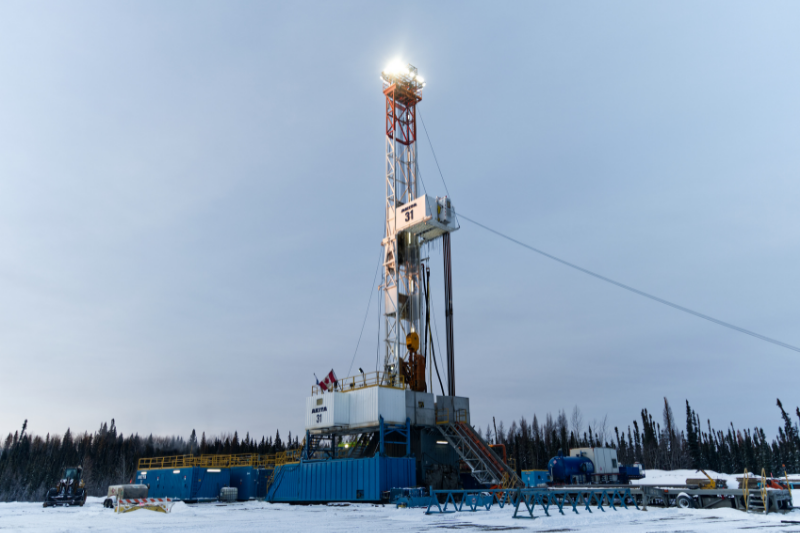
Context: With advances in binary and enhanced geothermal systems (EGS), low-to-mid temperature resources in sedimentary basins (common in former oil and gas fields) are now viable, making binary the fastest growing type of geothermal electricity. Tu Deh-Kah also represents a broader movement toward Indigenous climate leadership and energy sovereignty. Under frameworks like the UN Declaration on the Rights of Indigenous Peoples, projects like this support local control and long-term economic resilience.
Fun Fact
The Earth has A LOT of heat. In fact, just 0.1% of Earth's total heat could supply all of humanity's energy needs for 2 million years!
Most people don't know that about half of the heat inside the Earth is primordial, meaning it's leftover from when the planet first formed 4.5 billion years ago. The other half comes from the ongoing decay of radioactive elements like uranium, thorium, and potassium in Earth's crust and mantle. Read more about the Earth's heat.
Want to test your knowledge of geothermal energy?
Take our quiz
The data in this issue are current as of April 2025. For the most current data, visit our Geothermal Fast Facts.


