
Understand Solar Energy
Happy holidays! Our featured topic in this fourth edition of Stanford University’s Understand Energy Learning Hub newsletter is Solar Energy, with a focus on solar PV (photovoltaic) systems. If you like what you see, please share with your friends and family and encourage them to subscribe!
What you need to know
Significance: Solar energy is radiant energy from the sun, making it a fully renewable energy resource that is available everywhere. We use the solar resource to provide daylight, electricity, and heat, and we harness it with four different methods (in order of prevalence):

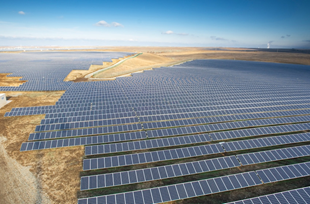
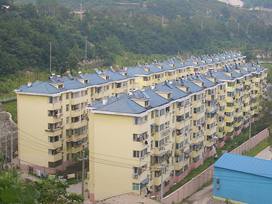
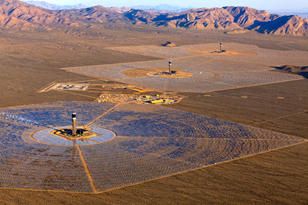
Solar energy is a relatively small part of our current energy mix. It meets 5% of global electricity demand and a little less than 1% of global heat demand. Solar PV, the biggest use of solar, is the fastest growing source of new electricity generation. Global solar PV electricity generation nearly tripled between 2018 and 2023–from 575 TWh to 1640 TWh, which is enough to power 145 million U.S. homes. China generates a third of the world’s solar electricity, over twice as much as any other country.
How does solar PV work? Solar PV departs from the way we have traditionally produced electricity. Traditional methods use thermal or kinetic energy to rotate a turbine that turns an electric generator. Solar PV has no mechanical conversions, no thermal conversions, and very few moving parts.
A solar PV cell contains two layers of semiconductor materials (typically silicon), each with different impurities introduced into them through a process called doping. The n-type layer is doped to have unbonded electrons that are free to move around, while the p-type layer is doped to have “holes” which are vacancies due to the absence of valence electrons. When the layers are put together, the electrons at the interface move from the n-type to the p-type, forming a depletion zone and a small electric field called the p-n junction.
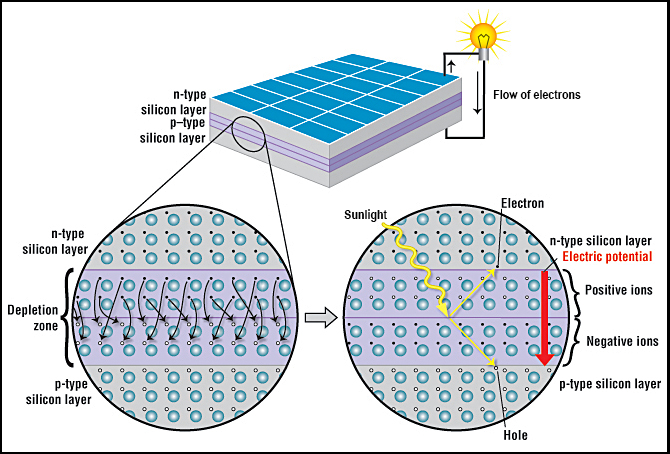
Semiconductors exhibit a property known as the photoelectric effect, which causes them to release electrons when they’re hit by sunlight. That means that when sunlight hits a PV panel, electrons are knocked loose from the atoms in the semiconductor material. Because there is an electric field at the p-n junction, the loose electrons move to the n-type layer and the “holes” move to the p-type layer. If you have an electric circuit connecting the n-type and the p-type, the electrons will travel from the n-type to the p-type via the circuit, generating electricity. This works for both direct sunlight and diffuse sunlight (cloudy days), although direct sunlight produces more electricity.
Unlike electric generators which generate alternating current (AC) electricity, photovoltaic solar cells generate direct current (DC) electricity. Inverters convert a PV system's output to AC for the grid.
The solar cell is the basic building block of a solar PV system. While silicon is the most common semiconductor material used in solar cells, many other types and configurations exist. An individual solar cell is 0.5 to 4 inches across and can typically only produce 1-2 W of power. To obtain a useful voltage and more easily harness the power of PV cells, cells are wired together in series to form larger units called modules. Modules (or "panels") typically have hundreds of cells wired together for 300-600 W of capacity. Modules can then be connected to form larger arrays in a project as shown below.
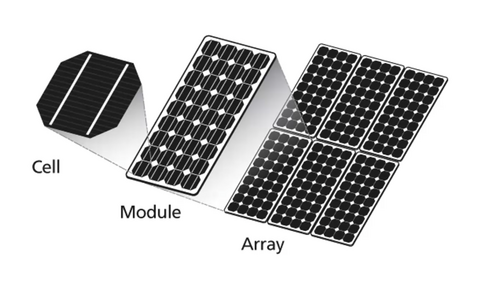
The power output of a module (or multiple modules connected in series) is limited by the current produced by the least efficient cell. If one cell is shaded or dirty, it reduces the current–and thus the power output–of the entire module.
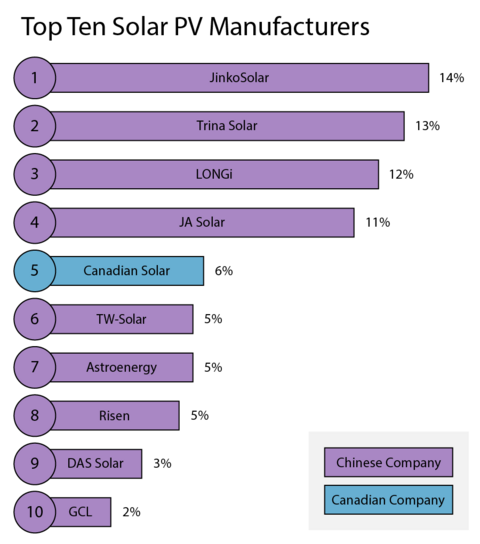
Where are solar cells made? Chinese companies dominate solar PV manufacturing. Nine of the top ten manufacturers are Chinese companies.
Drivers: Solar energy systems have extremely low climate and environmental impacts, emitting no greenhouse gasses or air pollutants when providing heat or producing electricity. Because of these low impacts, countries around the world have policies supporting solar energy.
The cost of utility scale solar PV has fallen dramatically over time, making it cheaper than fossil fuels and competitive with onshore wind. Solar PV is modular and easy to install anywhere.
As battery storage costs have declined, pairing solar PV with storage can economically provide near-firm power to the grid. This allows grid operators to integrate large amounts of solar electricity more easily.
Solar energy is an abundant, widely available resource that is available just about everywhere. The fuel for solar systems (sunlight) is free forever, unlike other resources such as fossil fuels.
Barriers: Solar energy is available only when the sun is out, creating challenges for integrating it into the grid. Grid operators must always balance electricity supply with demand, but tools are available for managing solar’s intermittency, including battery storage, regional integration, and demand response.
Supply chain constraints, inconsistent policy support, land use, and NIMBY are additional challenges for the solar industry. Solar PV recycling at end of life (~30 years) is not yet happening at large scales because it is cheaper to throw old solar panels in the landfill. The solar recycling industry is new and still growing, with researchers working on how to make the process more economical.
Current and future trends
Capacity: As one of the cheapest and cleanest sources of new power, solar is poised to continue to grow tremendously across the globe. The International Energy Agency predicts that 4,000 GW of new solar capacity will be added worldwide by 2030, nearly quadrupling current global solar capacity.
Innovations: New bifacial solar PV designs allow light to reach the solar cell from the back side as well as the front, increasing total electricity generation by up to 15 percent. Bifacial PV modules are experiencing significant growth and are projected to expand rapidly over the next several years, overtaking the market share of monofacial PV technologies. Agrivoltaics, the practice of pairing solar with agriculture, offers the potential for large scale solar systems to be built without taking agricultural land out of food production. Additional benefits of farming under solar panels may include reduced irrigation requirements and improved crop yield in extreme weather.
In the news
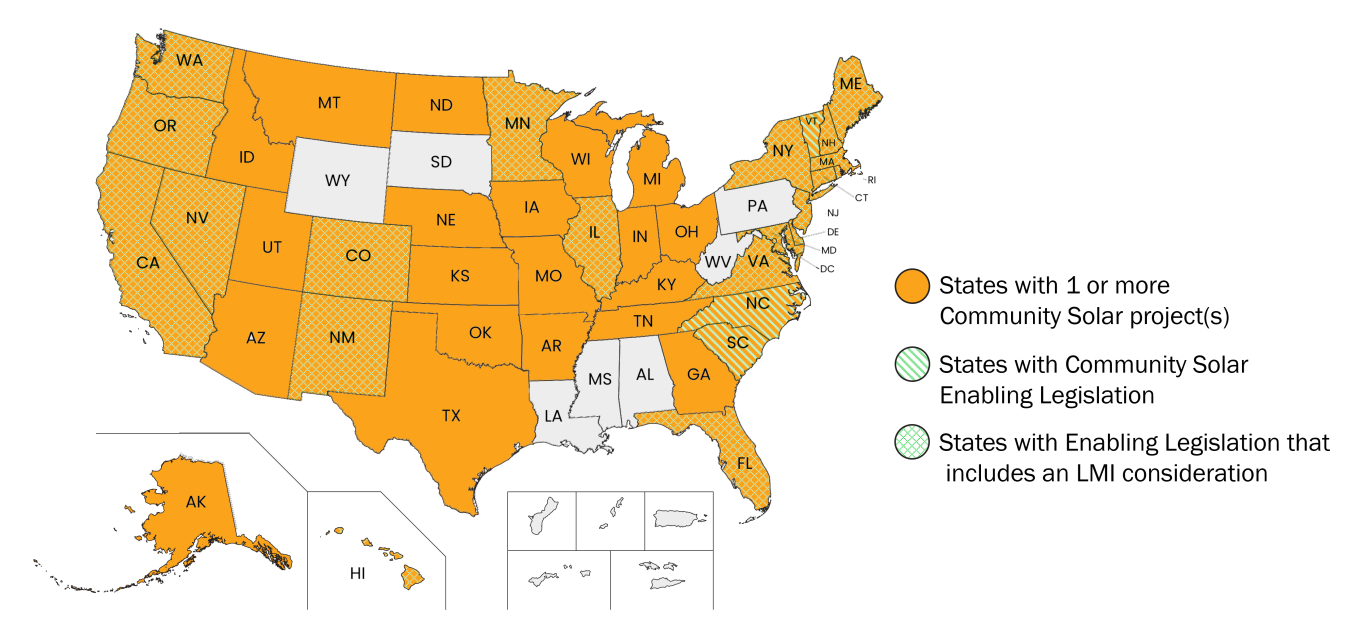
News: Solar and technology companies are expanding community solar in the U.S., benefitting renters and homeowners who are unable to install rooftop solar. Currently, the U.S. has 6.5 GW of installed community solar capacity (3% of its total installed solar capacity), and that is expected to more than double by 2028. Read this article about the growth of community solar for more information.
Context: Community solar works like a shared solar farm. Instead of installing panels on their own property, households and businesses can subscribe to a solar project and get credits on their electric bills. This helps lower energy costs and makes solar power accessible to more people. Legislation in 24 states and localities encourages or mandates community solar, with 19 states addressing the participation of low-income households in solar PV growth.
Fun Fact
Solar panels offset their manufacturing emissions after just 4-8 months of operation, even with an electricity-intensive manufacturing process that is currently powered primarily by fossil fuels. Read more in this IEA report executive summary.
Want to test your knowledge of solar energy?
Take our quiz.
The data in this issue are current as of December 2024. For the most current data, visit our Solar Fast Facts.


