
Understand U.S. Energy Policy
We're back in your inbox with the second edition of Stanford University's Understand Energy Learning Hub newsletter. With just two weeks to go until Election Day, we are taking a look at U.S. energy policy.
What you need to know
Significance: Policies at every level of government shape decisions about energy production and use. In the U.S., institutions ranging from the federal government to local municipalities use different policy instruments, such as building codes, financial incentives (e.g., tax credits or subsidies), and air quality standards, to influence energy-related behaviors. From household energy costs to the rapid transition toward net zero, energy policies in the U.S. and around the world affect nearly every aspect of our daily lives and the future of our planet.
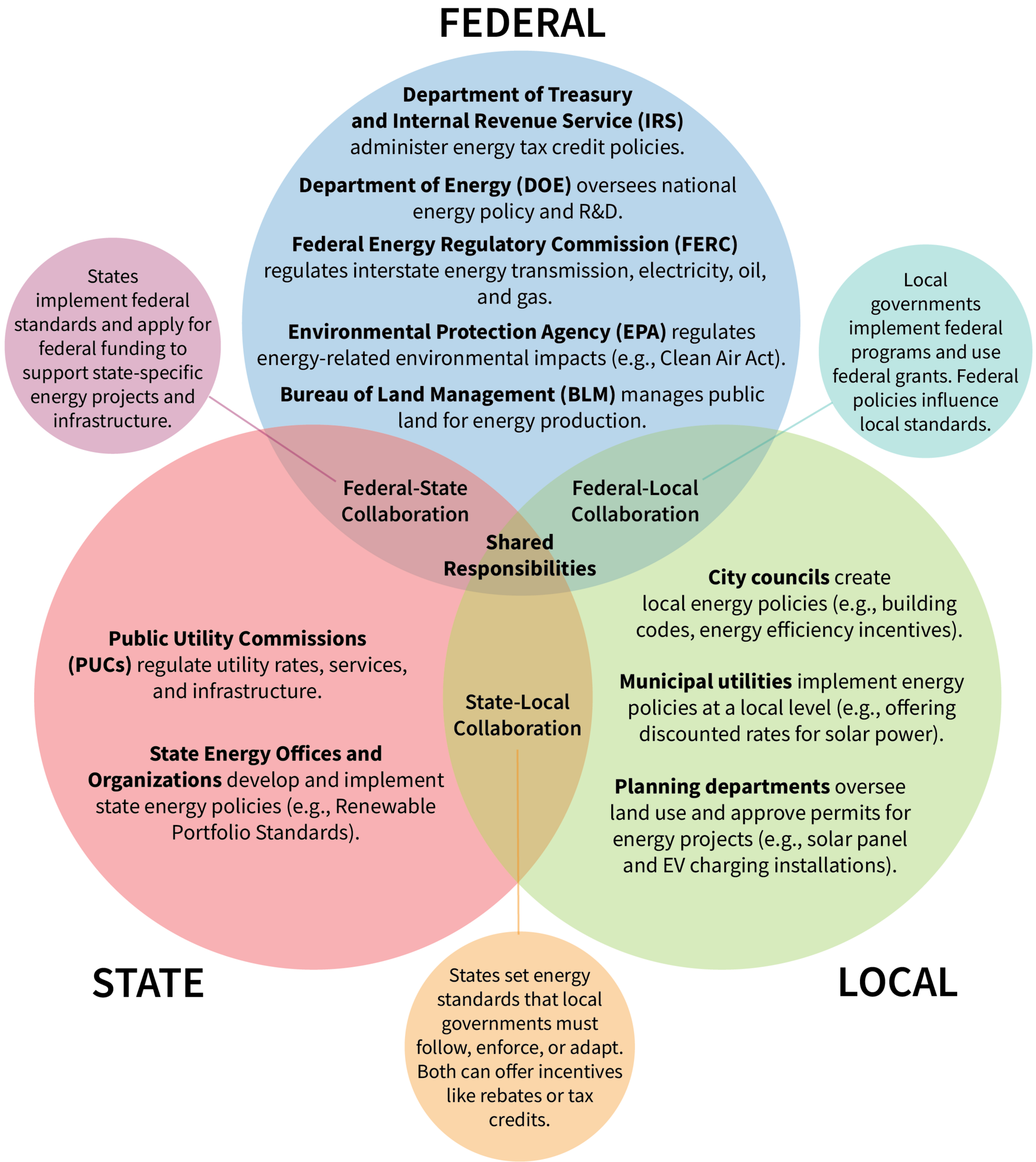
How does it work? U.S. energy policy is a complex landscape that expresses national interests through decisions made at federal, state, local, and tribal levels. Federal and state agencies are authorized and funded through laws passed by their respective legislative branches to set and enforce standards, pay for incentives, and invest in innovation. Native American tribes have sovereign nation status, which entitles them to set their own laws and standards as long as they align with overriding national policy. The U.S. also makes international commitments (e.g., the 2015 Paris Agreement) on energy and climate. The diagram below provides some examples of U.S. energy agencies and policies across multiple levels.
What's happening now in federal energy policy?
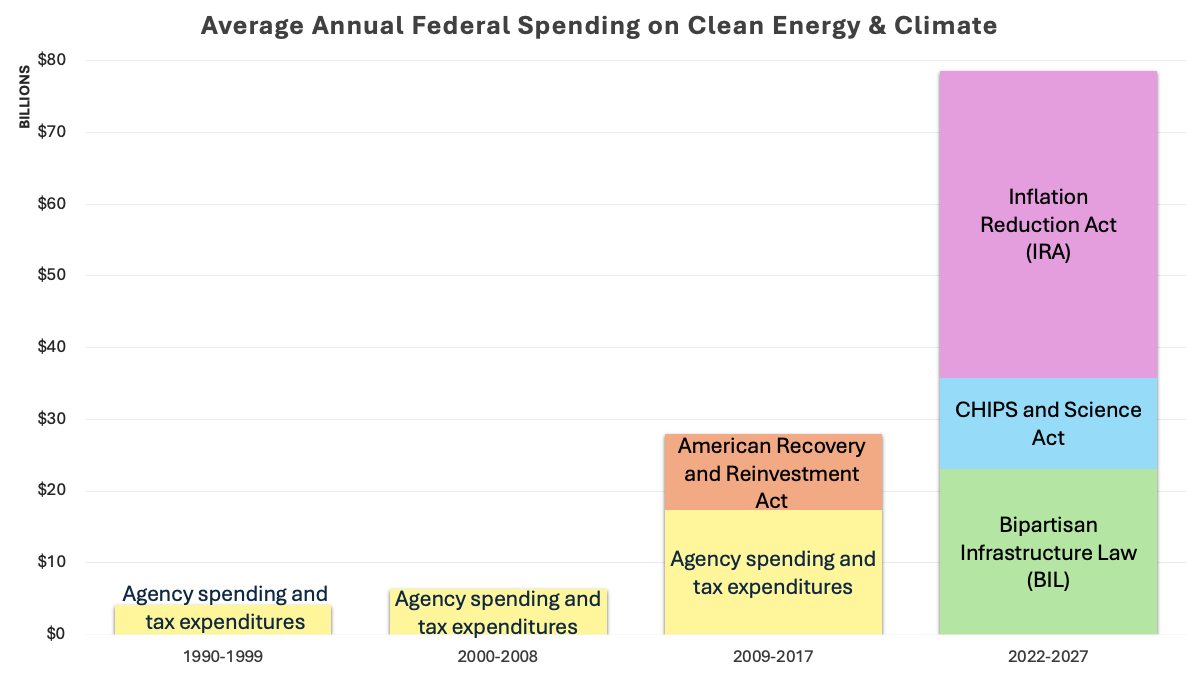
Today, we have more federal support for clean energy than ever before. That support comes in the form of existing mechanisms like tax credits (the number one category of U.S. federal energy policy by expenditure), rebates, and subsidies available to consumers and developers. Three key federal policies are driving new U.S. investment in clean energy.
Bipartisan Infrastructure Law - aka BIL (2021): Commits $76 billion to clean energy initiatives, resilience, and environmental remediation. This includes accelerating R&D for new technologies (e.g., battery recycling), modernizing and expanding the grid (e.g., adding new transmission to connect renewable energy to demand centers), and adapting to climate impacts (e.g., weatherizing homes and buildings). The BIL also includes $7.5 billion to build a national network of EV chargers.
CHIPS and Science Act (2022): Commits a portion of $52.7 billion for energy and climate programs (e.g., regional clean energy innovation, critical minerals mining R&D, low emissions steel R&D, and nuclear fission and fusion R&D). The CHIPS Act is primarily focused on American semiconductor (“chips”) manufacturing and workforce development.
Inflation Reduction Act - aka IRA (2022): Directs $400 billion or more toward amplifying the BIL and the CHIPS Act—channeling more funding toward their target sectors—and filling gaps. The IRA also expands funding for long-term efficiency and clean energy tax credits for things like EVs, solar panels, reducing home energy use, wind turbines, and geothermal power plants. For example, the Investment Tax Credit (ITC) and Production Tax Credit (PTC) are clean energy tax credits that have been extended and expanded by the IRA. And, for the first time, these tax credits are available to certain tax-exempt entities like tribal nations, non-profit utilities, governments, schools, and churches, unleashing huge expansion of solar PV development for these entities. Watch this video for more information about the IRA.
In addition, the Justice40 Initiative establishes an aim that 40% of the overall benefits of clean energy investments from the BIL, the CHIPS Act, and the IRA go to disadvantaged communities. Read more about Justice40.
Future trends
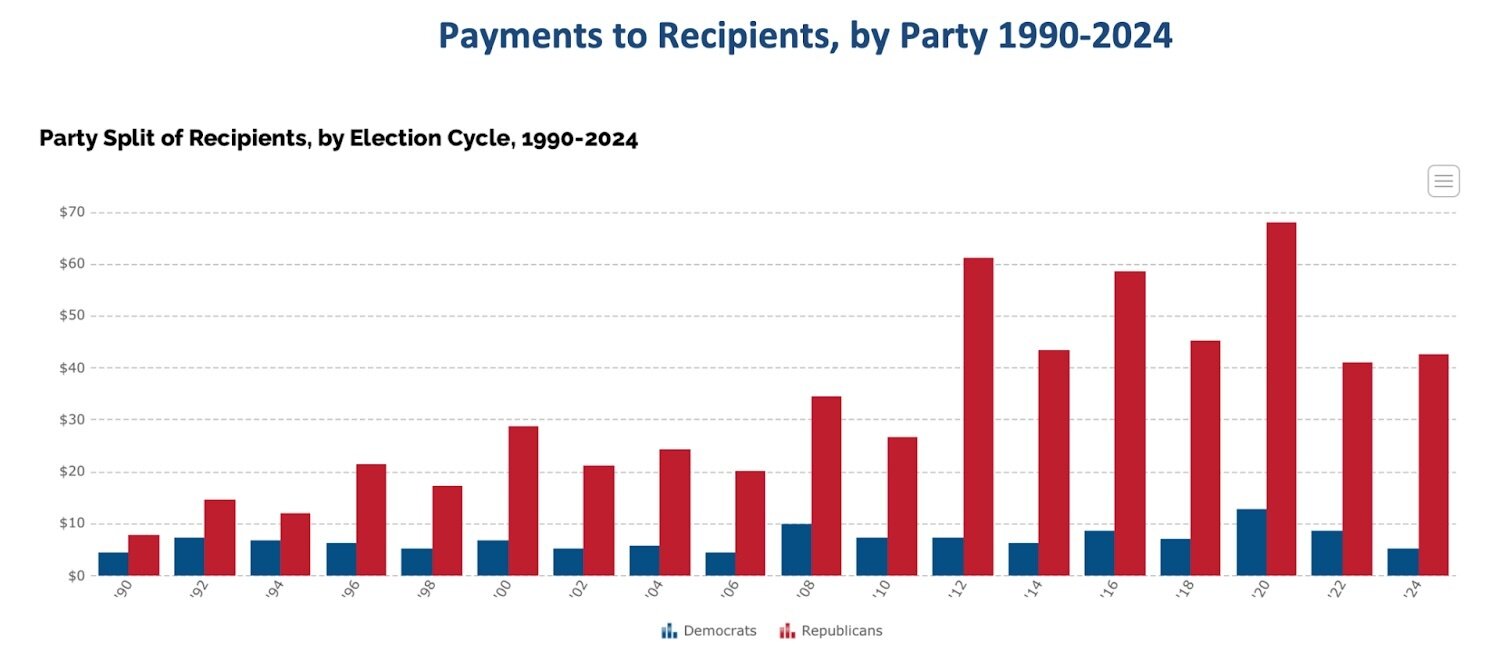
Clean energy transitions: U.S. clean energy transitions away from fossil fuels are expected to continue regardless of the 2024 election outcome. Market forces—particularly the plummeting costs of renewable energy—and concerns about climate change have led to widespread change across the energy sector. However, the focus on clean energy investments is different between the platforms of the two presidential candidates, as is the patronage of their two respective parties by the oil and gas industry reported in federal data and shown in the chart below.
Depending on the presidency and the balance of power in Congress, the pace of transition away from fossil fuels and growth of renewables in U.S. energy production could change.
Equity: Justice40 transformed the U.S. energy policy landscape by allocating funds to underserved and “fenceline” communities. When disadvantaged communities are included in the clean energy transition, it benefits everyone (e.g., clean air and cheap electricity in more neighborhoods improve public health and boost the economy). The emphasis on energy justice and equity differs between the two political parties.
Trade policy: Clean energy trade policy in the U.S. is expected to see bipartisan support, with both parties interested in reshoring and expanding energy-related production. However, their approaches differ: Democrats favor funding clean energy innovation, while Republicans emphasize tariffs and boosting domestic fossil fuel production. Both parties support investment in domestic supply chains to some degree.
In the News
News: With funding from the BIL, the U.S. Environmental Protection Agency's Clean School Bus Program provides $5 billion dollars in grants and rebates to replace existing school bus fleets with clean and zero-emission school buses. To date, nearly $3 billion have been awarded to more than 1,300 school districts to replace 9,000 school buses. Read this article to learn more about the implementation of the Clean School Bus Program.
Context: The U.S. diesel-fueled school bus fleet contributes about 8 million metric tons of carbon emissions each year and emits air pollutants that are harmful to the health of the children who ride in them and the communities in which they operate. Electrification of the school bus fleet will eliminate many of these hazardous impacts, but electric school buses are two to three times more expensive than their diesel-fueled counterparts. The Clean School Bus Program aims to help districts cover the costs of electrification and prioritizes lower-income and disadvantaged school districts for its awards.
Fun Fact
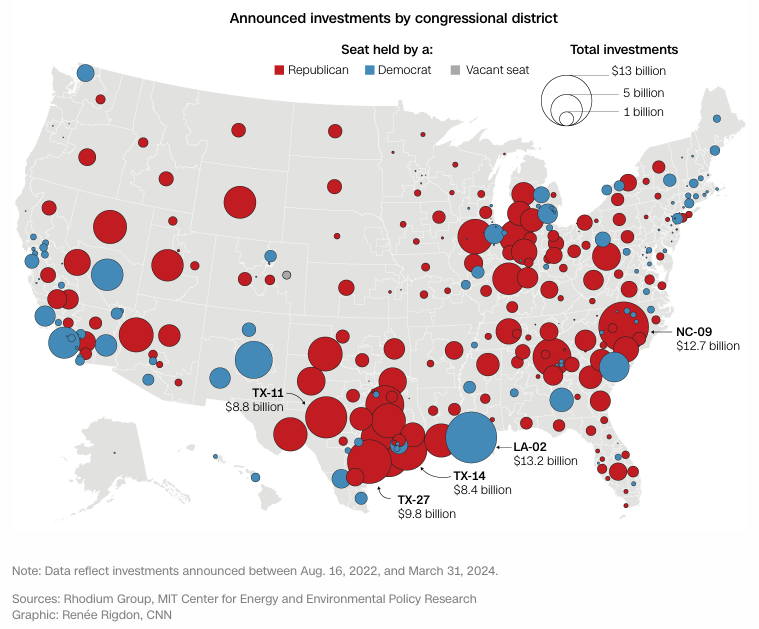
As of August 2024, about 85% of the IRA-related clean energy investments (representing almost 60% of the announced projects) are in Republican congressional districts.
Want to test your knowledge of U.S. energy policy?
Take our quiz.
The data in this issue are current as of October 2024. For the most current data, visit our Energy Policy Fast Facts.


